
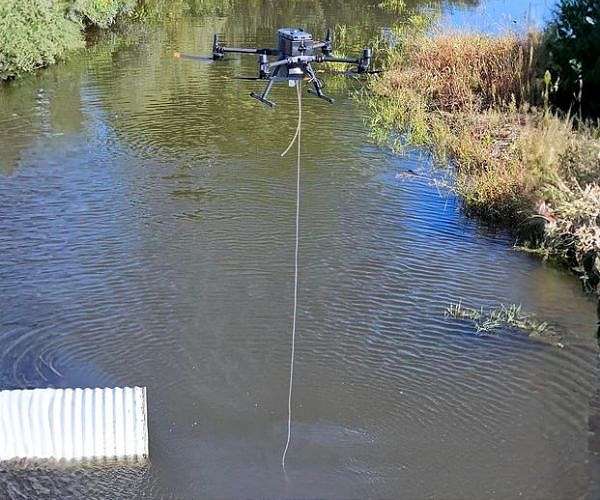
What if instead of bringing water or soil samples back to a laboratory, researchers could transport the lab directly to the field? That is the approach a team reporting in ACS Sensors has taken with a drone-based nitrate monitoring system that functions as a lab-on-a-drone for agricultural watersheds. The system is designed to collect and analyze water samples in real time from locations that are difficult to reach on foot, such as steep drainage ditches and swampy lowlands. The researchers report that the platform can support farmers and land managers in adjusting fertilizer use and limiting nitrate-rich runoff that can pollute streams, rivers, and drinking water sources.
Nitrogen fertilizers underpin much of modern crop production, yet a large fraction of applied nitrogen does not remain in the root zone and instead moves into field drainage and surrounding waterways. As this nitrogen is transformed into nitrate, it can promote algal blooms and contribute to low-oxygen dead zones, while elevated concentrations in drinking water supplies pose risks to human health. Monitoring these concentrations is challenging because many drainage points and ditches are remote, often muddy, and poorly suited to frequent manual sampling, and samples typically must be shipped to centralized laboratories for analysis. To address these constraints, Jonathan Claussen and colleagues set out to build a remotely operated lab-on-a-drone platform that could monitor nutrient pollution at lower cost and with greater efficiency than existing systems.
The team integrated a custom fluid-handling pump, low-cost electrochemical nitrate sensors, and a potentiometric device into a compact analytical package, then mounted this assembly on a commercially available drone. A long intake tube suspended beneath the drone draws water from the target location into the onboard mini laboratory, where electrochemical measurements quantify nitrate concentrations while the drone hovers. Each measurement cycle takes about seven minutes, and the drone can handle multiple water samples during a single flight before returning to the ground. All data are stored on an onboard memory card for later retrieval and detailed analysis.
In performance tests, the electrochemical sensor system detected nitrate at concentrations as low as 2.5 parts per million and delivered results that were 95% as accurate as those from a typical laboratory-based electrochemical nitrate detection setup. Field trials in a drainage ditch at an agricultural site in Iowa yielded average nitrate concentrations of 5.39 parts per million, matching previous measurements from the same area and remaining below the 10 parts per million maximum contaminant level for drinking water established by the U.S. Environmental Protection Agency. These results indicate that the lab-on-a-drone platform can provide reliable readings under real-world conditions in working farm landscapes.
According to the researchers, this configuration simplifies nitrate pollution monitoring in agricultural watersheds and offers a foundation for further lab-on-a-drone applications. Future variants could be adapted to detect bacteria, pesticide residues, or other contaminants in surface waters linked to farming and land management. The authors have filed a U.S. patent in connection with this work and report financial support from the National Science Foundation, the National Institute of Food and Agriculture of the U.S. Department of Agriculture, and the Digital and Precision Agriculture Applications Funding Opportunity at Iowa State University.
Research Report:Lab-on-a-Drone: Real-Time Electrochemical Sensing of Nitrate in Agricultural Watersheds
