
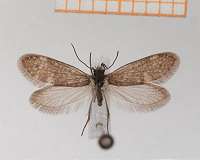
Researchers working in Germany have unearthed the earliest known fossil evidence of insects from the order Lepidoptera, which includes butterflies and moths. The fossils, mostly wing scales, provide important insights into lepidopterans' evolutionary history, which has been murky to date.
To make their discoveries, T.J.B. van Eldijk and colleagues analyzed about 70 wing scales and scale fragments from a drilled core in northern Germany, which dates to the Triassic-Jurassic boundary approximately 200 million years ago.
They uncovered a variety of morphologies among the fossilized scales, which can be assigned to various surviving clades, they say. Perhaps most notably, some of these very old fossilized wing scales show characteristics of living Glossata, moths with a sophisticated sucking feeding device known as a proboscis.
Glossatan moths mostly feed on angiosperms, plants that produce flowers; because the findings from this group suggest Glossata may have originated earlier than angiosperms, however, lepidopterans likely depended first on gymnosperms, which don't produce flowers, to satisfy their nutritional needs, say the authors, later shifting to angiosperms as a primary food source.
This shift in host food preference from gymnosperms to angiosperms challenges the notion that the development of the sucking proboscis was an adaptive response to the evolution of angiosperm flowers.
The authors also hypothesize a reason for the evolution of the sucking proboscis found in most lepidopterans, and replacing the chewing mouthparts of earlier lineages; the transition to exclusively feeding on liquids via the proboscis was most likely an evolutionary response to widespread heat and aridity during the Late Triassic, they say. The authors believe their results will be an important basis for future studies of butterfly and moth evolution.
An adaptation 150 million years in the making
Just how do snapping shrimp snap? This was the question plaguing scientists who set out to uncover the mysterious mechanisms producing big biology in tiny crustaceans.
"All we've known until now is the endpoint of these super snapping claws," said Rich Palmer, biological science professor at the University of Alberta and senior author on a new study on snapping shrimp claws.
"What we … read more
