
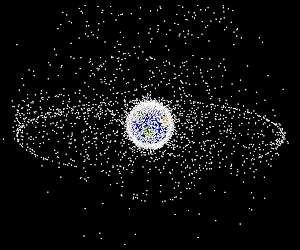
Man-made garbage cluttering from near space is a very intensive process. Therefore, it may happen that within the coming 20 years safe near-Earth orbits which it would be possible to use will become non-existent. This is a very gloomy forecast but this is exactly what the Head of the Russian Federal Space Agency (Roscosmos) Vladimir Popovkin said, when he was speaking in the Russian Federation Council.
Vladimir Popovkin said that 3 years ago the probability of collision between a spaceship and space garbage more than 1 centimeter in diameter happened once every 5 years while today the interval ranges from 1.5 to 2 years.
For example, the crews of the International Space Station (ISS) had to maneuver at least once in a year in order to leave the zone where a collision with big objects is possible. When a satellite, a spaceship or an international space station collide with a space object, this resembles a collision with car travelling at 80 kilometres per hour.
To hamper the "multiplying" and the pulverization of space garbage is impossible. As a result, a great number of objects are chaotically orbiting the Earth, destroying the space junk on their way.
There are dozens of various satellites on the geostationary orbit today, and although the majority of them are still functioning, they have already turned into space junk.
According to various services, more than 14,000 artificial objects are currently working or simply staying on the geostationary orbit. Among them are objects more than 10 centimetres in diameter, a member of the Russian Federation of Cosmonautics, Alexander Zheleznyakov, said in an interview with the Voice of Russia.
The number of smaller pieces exceeds hundreds of thousands, and to track them down from the Earth is practically impossible, Zheleznyakov said, adding that the old spaceships with nuclear reactors on board are deployed on the disposal orbit – some 38,000 kilometres over the Earth's surface.
Thus, space debris continues to grow, posing a threat to spaceships, orbital spaceships, space stations, and of course, to people and nature. However, space launches must continue because our civilization will not be able to survive without the global communication systems. Various proposals were made to resolve this problem. Before the Soviet Mir station was sunk into the ocean, a proposal was made to use it as a space dump truck.
However, at the moment there are no projects which could prove helpful in cleaning space .The situation is becoming more and more aggravated with every passing day – that is why it would be good to step up the work in this field. Otherwise, people will be ousted from space by space garbage.
Source: Voice of Russia
