
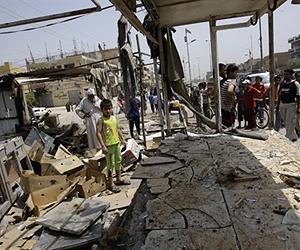
Insurgents lured Iraqi troops into a booby-trapped house early Wednesday, killing eight soldiers in co-ordinated blasts that marked the start of Ramadan when violence typically peaks.
Three other bodies were found under the rubble of the building, but it was not immediately clear if they were of insurgents or civilians, security and medical officials said.
Gunmen initially opened fire on an army checkpoint at around 5:00 am (0200 GMT) in the town of Saadiyah, 100 kilometres northeast of Baghdad, before fleeing into a nearby house, as a group of soldiers gave chase.
"The house then collapsed because of a bomb," said army Captain Mohanned Ibrahim. "The gunmen escaped through a back door."
Major Hussam Karim at the provincial security command said the initial house bomb had killed six troops and wounded two others, while a second, delayed, bomb hidden in the property's garden killed two soldiers and injured two.
"Now the area is cordoned off, and the army has imposed a curfew, and is searching for the armed men," Karim said.
Dr. Abdulrazzaq Mustafa at Saadiyah hospital confirmed the toll, and all three officials noted that three bodies had been found that could not be accounted for.
Also on Wednesday, the head of a maternity hospital in Baghdad was shot dead by gunmen who tied up her husband before killing her.
"Armed men entered the home of Dr. Intissar Hassan Mohammed, chief of the Al-Alwiya maternity hospital, in Karrada (central Baghdad) this morning," an interior ministry official said, speaking on condition of anonymity.
He said Dr. Mohammed was shot dead but her husband was spared.
According to the Iraqi medical association, the country counted some 34,000 doctors in the 1990s, but that number dropped to just 16,000 in 2008, in the aftermath of the chaos that followed the US-led invasion that ousted dictator Saddam Hussein during which time doctors and nurses were targeted.
The violence comes as Iraq observes Ramadan, which began on Wednesday for Iraq's Sunnis and will start Thursday for the country's majority Shiites. In previous years the Muslim holy month of fasting has coincided with a spike in insurgent activity.
The unrest this month — more than 100 people have died already in August — and in July, which was the deadliest month since 2008, has fuelled concerns about security here as the United States pulls out thousands of troops from Iraq. US officers insist Iraqi soldiers and police are up to the task.
Iraq's army chief of staff has said, however, that the country will continue to require American support for another decade before Iraq's forces are ready to handle its security.
"At this point, the withdrawal (of US forces) is going well, because they are still here," Lieutenant General Babaker Zebari said.
"But the problem will start after 2011 — the politicians must find other ways to fill the void after 2011, because the army will be fully ready in 2020.
"If I were asked about the withdrawal, I would say to politicians, the US army must stay until the Iraqi army is fully ready in 2020."
Iraq is also grappling with a five-month-long political impasse after a March 7 parliamentary election failed to produce a clear winner, ushering in as yet fruitless coalition negotiations between the leading parties.
Share This Article With Planet Earth
