
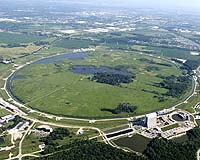
Equipment critical to the world's greatest atom-smasher, the Large Hadron Collider (LHC) in Switzerland, failed during a test, the European organisation for nuclear research CERN said Tuesday. Three 13-meter (43-foot) magnets manufactured and installed by the Fermi National Accelerator Laboratory (Fermilab) in the United States — which is in friendly competition with CERN to identify a key elementary particle — came apart when subjected to 20 times normal atmospheric pressure.
The magnets are used to focus particle beams prior to collision in the accelerator, which runs some 27 kilometers (17 miles) at a depth of 100 meters (325 feet) underground along the Franco-Swiss border.
The incident on March 27 did not cause any casualties, both laboratories said.
The collider is scheduled to go into operation in November 2007.
"At this time, the consequences — if there are any — on the calendar for the Large Hadron Collider are not known," Fermilab said in a statement, published on its own site and on CERN's.
According to the Fermilab statement, the structure holding the trio of super-magnets in place failed. Fixing the problem "has the highest priority for Fermilab," it said, adding that "whatever is necessary to get things back on track" would be done.
Earlier tests, the American lab acknowledged, had not subjected the magnets to "asymmetric loads" such as might occur during cooldown or refrigeration failure.
The LHC accelerator will allow physicists to conduct experiments that promise to resolve remaining mysteries on sub-atomic particles.
The biggest quest is to identify the so-called Higgs Boson, a suspected particle whose existence would explain mass.
CERN has no suspicion that the failure was in any way deliberate on the part of Fermilab, a spokeswoman, Sophie Tesauri, said in response to a question.
"Their scientific credibility would be compromised. It is in their interest that LHC function properly," she said.
Source: Agence France-Presse
