
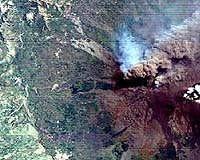
Sicily's volcano Mountain Etna volcano rumbled back to life on Tuesday with "seismic events" measuring up to 3.9 on the Richter scale, a vulcanologist said three days after minor eruptions shook the cone.
"For now there is no danger to inhabited areas because this activity is mainly at the top of the crater at about 3,000 meters (10,000 feet)," an official at the National Geophysics and Vulcanology Institute in Sicily's Catania region told AFP.
Meanwhile another Italian volcano, Stromboli, one of the most active in Europe, also rumbled and shook into life again Tuesday, forcing cancellation of tourist excursions.
"We now have two Sicilian volcanoes particularly active," ANSA news agency quoted civil protection official Guido Bertolaso as saying.
"Stromboli is currently in a particular phase of activity but is behaving according to standard form," he stressed.
The small island of Stromboli off Sicily has about 400 inhabitants and receives some 6,000 tourists every summer.It last erupted spectacularly in February and March last year without danger to the populace.
The tremors on Etna, Europe's tallest active volcano at 3,295 metres (10,810 feet), first struck at dawn on Tuesday, followed by a rain of ash on the southeast crater and "significant gas emissions," the institute said earlier.
The final tremor, early Tuesday afternoon, was the strongest at 3.9 points, the vulcanologist said.
Saturday's eruption, accompanied by streams of lava, was also at the volcano's southeast crater.
Magma burst open the same part of Etna in late 2002 when immense lava flows destroyed homes and tourist areas while prompting the evacuation of hundreds of area residents.
The eruption produced a cloud of ash that blew as far south as Libya.
Mount Etna last erupted in November 2007, two months after another eruption forced a temporary closure of nearby Catania airport because of lava flows and clouds of ash.
The last major eruption was in 2001.
"Weather conditions are preventing us from monitoring on the ground, but the volcano is in a very active phase, especially on the northern and eastern flanks," public safety official Guido Bertolaso told the ANSA news agency on Tuesday.
"A team of vulcanologists will go to the scene to evaluate the situation," he added.
