
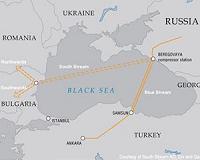
Though most parties to the South Stream consortium are holding their tongues, an Italian company said it's received no formal notice the program was over.
Russian President Vladimir Putin said Tuesday from the sidelines of a state visit to Turkey the South Stream natural gas pipeline "will not be carried out" because of obstacles in European Union member states.
South Stream is Russia's answer to energy security issues in Europe. Most of the Russian gas bound for the European market runs through risky Ukrainian territory and South Stream would avoid that legacy route.
In September, the European Parliament passed a resolution calling on member states to cancel planned energy sector agreements with Russia, including the South Stream gas pipeline. Europe is trying to add a layer of diversity to an energy sector that depends on Russia for about a quarter of its gas supplies.
Saipem, the contracting subsidiary of Italian energy company Eni, said it's received no word on the status of South Stream, but was aware of Putin's announcement.
"Operational activities therefore continue to progress," the company said. "The potential interruption of work and any possible cancellation of the project are subject to the terms of the contract."
German steelmaker Salzgitter AG said it would seek compensation for the demise of the project from its insurers. It's party to contracting partner Europipe, a member of the South Stream pipeline consortium.
South Stream AG, the official project leader, hasn't issued a formal statement on the status of the project. Consortium member OMV did not respond to repeated requests for comment.
Though South Stream is considered a diplomatic defeat for Putin, leaders in the Russian energy sector have expressed interest in strengthening ties with emerging Asia.
Officials from Russian gas company Gazprom met Wednesday in Shanghai to discuss pipeline developments in China.
In May, Russian gas company Gazprom signed a 30-year sales agreement with China that calls for 1.3 trillion cubic feet of natural gas per year through the so-called Power of Siberia pipeline.
