
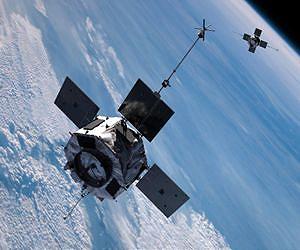
At NASA's Kennedy Space Center in Florida, the Flight Readiness Review for the agency's Radiation Belt Storm Probes spacecraft and the United Launch Alliance Atlas V rocket is complete.
There were no significant issues identified that would be a constraint to launch on Aug. 23. A launch countdown dress rehearsal will be conducted on Friday. The Launch Readiness Review is to be held Aug. 20 and will give the launch team the nod to proceed toward liftoff, with rollout of RBSP atop the Atlas V on Aug. 21.
The Radiation Belt Storm Probes (RBSP) is being designed to help us understand the Sun's influence on Earth and Near-Earth space by studying the Earth's radiation belts on various scales of space and time.
The instruments on NASA's Living With a Star Program's (LWS) Radiation Belt Storm Probes (RBSP) mission will provide the measurements needed to characterize and quantify the plasma processes that produce very energetic ions and relativistic electrons.
The RBSP mission is part of the broader LWS program whose missions were conceived to explore fundamental processes that operate throughout the solar system and in particular those that generate hazardous space weather effects in the vicinity of Earth and phenomena that could impact solar system exploration.
RBSP instruments will measure the properties of charged particles that comprise the Earth's radiation belts, the plasma waves that interact with them, the large-scale electric fields that transport them, and the particle-guiding magnetic field.
The two RBSP spacecraft will have nearly identical eccentric orbits. The orbits cover the entire radiation belt region and the two spacecraft lap each other several times over the course of the mission.
The RBSP in situ measurements discriminate between spatial and temporal effects, and compare the effects of various proposed mechanisms for charged particle acceleration and loss.
