
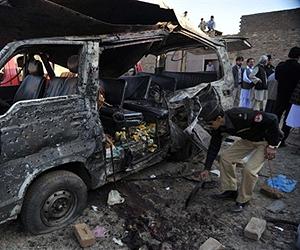
At least 40 people died and dozens were injured in a double suicide bomb attack near Pakistan's northwest border with Afghanistan.
The blast happened in a protected government administration compound during a meeting between government officials, local tribal leaders and groups opposed to the Taliban.
"There were two bombers. They were on foot," a local official said.
"The first blew himself up inside the office of one of my deputies while the second one set off explosives when guards caught him."
The attack happened in Ghalanai, the main town in the Mohmand Agency, one of the Federally Administered Tribal Areas. Ghalanai is around 110 miles from Islamabad.
The tribal area comprises the separate, semi-autonomous administrative units of seven agencies and six smaller frontier regions lying along the politically sensitive border with Afghanistan.
The mainly pastoral and exceptionally rugged FATAs, which have many trade routes over the mountains — smuggling is widespread — have a population of around 3.2 million, less than 3 percent of Pakistan's total population.
The Taliban and al-Qaida heavily influence the area, one of the poorest regions in the country.
The Pakistani army's offensive against extremist groups has displaced an estimated 2 million people in the FATA. Because the loosely administered area is close to Afghanistan, foreign governments, as well as that of Pakistan, strongly advise against traveling there.
At the end of last month, six people, including two small boys and one policeman, died in another suicide bomb blast in Bannu, a town within Khyber Pakhtunkhwa province, previously called the North-West Frontier province, directly south of the FATAs.
In that attack, a man was walking close to a police van, thought to be the target, when he detonated the device, local police said.
Extremist groups increasingly attack meetings between federal administrators and local leaders. Last July, another double suicide bombing in the village of Yakaghund in Mohmand Agency killed more than 100 people at a local meeting.
A recent report compiled by Pakistan's Federal Investigation Agency's Counter-Terrorism Wing said the death toll from this year's 37 suicide bomber attacks climbed to more than 640 and injured more than 1,800 people. Most of the people killed and injured in the suicide bombings were civilians but there have been several political leaders targeted.
Physical targets include government and security offices, personnel and public property, mosques, shrines and schools.
Of the 37 attacks, 25 took place in Khyber Pakhtunkhwa. Vehicles filled with explosives were used in 10 of the attacks.
For several years, the Pakistan government, supported by foreign aid donations, especially from the United States, has been working with tribal leaders in the FATAs to make accommodation with extremist groups less appealing.
A report in The New York Times in July 2007 said the United States was pouring millions of dollars of aid into the FATAs over the next five years as part of a "hearts-and-minds" campaign to win over the local population.
However, given the poor administration of the area, what happens to the money has been a major issue, the article said. How much aid money gets down to the grassroots level to improve the ordinary person's life is cause for concern.
"Delivering $150 million in aid to the tribal areas could very quickly make a few people rich and do almost nothing to provide opportunity and justice to the region," said Craig Cohen, author of a study of U.S.-Pakistan relations at the Center for Strategic and International Studies in Washington.
earlier related report
US strategy is paying off in Afghanistan: Gates
Kabul (AFP) Dec 9, 2010 –
Defence Secretary Robert Gates on Wednesday said he was "convinced" the US strategy in Afghanistan was paying off, a year after President Barack Obama ordered in reinforcements.
Signalling the outcome of a White House review of the war due out this month, Gates said his visit to key battlefronts over two days confirmed that the Taliban was losing ground and under mounting pressure.
"I will go back convinced that our strategy is working and that we will be able to achieve key goals set out by President Barack Obama last year" and endorsed by NATO allies at a November summit, Gates told a joint press conference with Afghan President Hamid Karzai.
"The bottom line is that in the last 12 months, we've come a long way, making progress that even just in the last few months has exceeded my expectations," he said.
US officials and commanders have suggested for months that they will stick with the current strategy, but Gates' emphatic public comments — his strongest to date — leave little doubt that Washington will maintain its massive troop presence with no major withdrawal on the horizon.
The strategy involves nearly 100,000 US troops plus more than 40,000 allied forces, engaged in a bloody, painstaking counter-insurgency fight as well as a costly effort to train and arm the Afghan army and police.
The approach is aimed at pushing back the Taliban from towns in the south and east while building up Afghan forces and local governments.
The deaths of two more NATO soldiers on Wednesday underscored the high cost of the nine-year-old war, and it remains far from clear whether the strategy will force the Taliban to sue for peace.
The NATO losses brought the number of foreign troops killed in 2010 to 682, according to an AFP tally based on the independent icasualties.org website.
The alliance lost 521 troops in 2009.
Gates acknowledged the rising death toll, saying NATO leaders had warned the surge would mean more combat and a temporary spike in casualties.
"But there is no denying that the security climate is improving and that the sacrifices of Afghan and coalition troops are achieving greater safety and security for both our nations," Gates said.
Earlier, the Pentagon chief paid a visit to the mainly Pashtun southern provinces of Helmand and Kandahar, where the military believes the outcome of the war will be decided.
Commanders who met with Gates told reporters the insurgents had been pushed out of most of the key population centres in Helmand province, where thousands of Marines have deployed, and that a months-long campaign had secured roads and towns west of Kandahar city.
Members of the 101st Airborne had "cleared" the Taliban from a main route and nearby areas in Zari district west of Kandahar city, and forced them out of Sang Sar, a town known as the birthplace of the Islamist insurgency, officers said.
Senior officers in Helmand and Kandahar said the security gains would pave the way for an eventual handover to Afghan forces in some districts next year, in line with allied plans.
NATO leaders at a summit last month in Lisbon endorsed plans for the beginning of a "transition" to Afghan forces providing security across the country in 2011, with an aim of ending the combat mission by the end of 2014.
Obama has promised to start the drawdown of some troops by July next year, though officials suggested only a small number would depart.
As Gates hailed the fruits of the US troop buildup, a video emerged purportedly released by the Taliban and appearing to show Bowe Bergdahl, the US soldier captured in Afghanistan in June 2009.
The IntelCenter monitoring group said the video contains brief "new footage" of someone who appears to be Bergdahl and another who seems to be "Taliban commander Maulawi Sangin", who had threatened to kill Bergdahl in July 2009.
Share This Article With Planet Earth
