
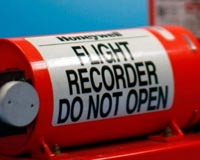
A French nuclear submarine launched a high-tech undersea sweep Wednesday to track down the black boxes missing after an Air France flight plunged into the Atlantic.
The Emeraude, a nuclear hunter-killer sub, will use its sensitive sonar to probe the ocean depths off Brazil in a race to find the flight data recorders before their locator beacons run out of power.
If the boxes are not recovered within three weeks they might never be found, complicating the investigation into the loss of Air France Flight 447 from Rio to Paris, which crashed on June 1 with the loss of 228 people.
"The Emeraude has begun its search operations," said French military spokesman Captain Christophe Prazuck said in Paris.
The first search zone measured 36 kilometers by 36 (22 miles by 22), which the sub should cover in a day, Prazuck said.
"It will change zone each day and no time limit has been set," he said, adding that the Emeraude would be joined in the area by the Mistral, a naval command and control vessel equipped with a Panther helicopter.
Brazil has a large naval and air force contingent in the crash zone, which, along with a French navy frigate, has already recovered some plane debris and at least 41 bodies.
The first 16 of those bodies were due to arrive by plane later Wednesday in the Brazilian mainland city of Recife for identification using DNA samples from relatives.
The other 25 were to follow after being delivered by ship to the Atlantic archipelago of Fernando de Noronha, 370 kilometers off-shore.
French officials acknowledge the hunt for the black boxes will not be easy and success is far from guaranteed.
The black boxes are thought to be in waters as deep as 6,000 meters (20,000 feet) and 1,100 kilometers (700 miles) from the Brazilian coast.
If the Emeraude does locate the signal, the French scientific research vessel Pourquoi Pas will launch a mini-submarine — one which was used to survey the wreck of the Titanic — to retrieve the recorders.
"The Emeraude will operate a bit like an airship hovering over a mountain chain and searching with binoculars," Captain Jerome Erulin, spokesman for the French navy, told AFP in Paris.
Preparations were also underway to equip two French tugboats with underwater pinger locators on loan from the US military that could pick up the black boxes' signals.
It is still not known what brought down the Air France jet.
No distress call was received from the pilots, but a series of 24 electronic warnings were sent automatically by the airliner's final four minutes as its flight systems shut down one by one.
The messages have focused suspicions on the plane's exterior airspeed sensors, known as pitot probes. There is speculation the tubes may have iced up during a storm at high altitude.
If the plane was flying too slow the airliner could have stalled, or if the Airbus was flying too fast it could have ripped the airframe apart, aviation experts say.
The French airline has stepped up a program to install a newer type of pitot tubes on its A330 and A340 aircraft after pilots' unions threatened to refuse to fly.
The European air safety agency said Tuesday that Airbus models were "safe to operate," but added that a bulletin had gone out to remind airlines of what to do "in the event of loss of, or unreliable, speed indication."
French police on Wednesday said meanwhile that an investigation into two passengers on flight AF 447 whose name corresponded with those of two suspected Islamist militants drew a blank.
The two passengers were "simple namesakes" and not the suspects in question, a senior officer told AFP, adding that this line of enquiry had been dismissed.
Share This Article With Planet Earth
