
All over the world, humans are doing their best to avoid crowds. But for many animals, there is still safety in numbers. In herds or schools, animals can momentarily let down their guard and focus on grazing and foraging.
But the safety of a crowd isn't simply a numbers game. Herding or schooling behavior allows animals to take advantage of social cues. Until now, scientists had only identified social cues of danger, a shriek or yelp, for example. It turns out, at least one animal uses a social cue of safety.
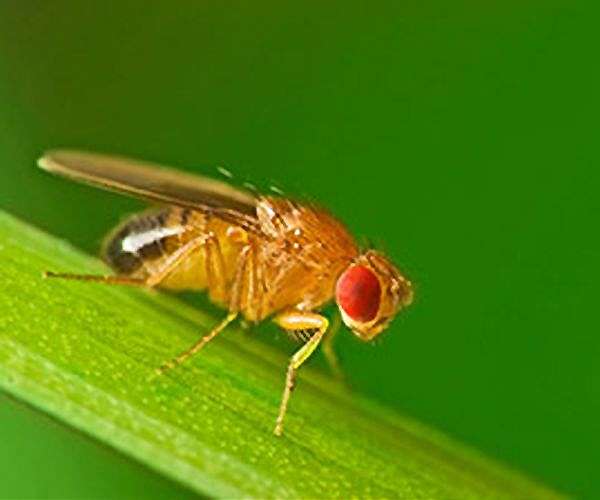
Scientists discovered the world's first known social cue of safety while observing how different numbers of fruit flies respond to an imminent threat.
"When people think about social communication of danger, they normally think about alarm calls," Marta Moita, a principal investigator at the Champalimaud Center for the Unknown in Portugal, said in a news release. "But we are interested in a different type of threat cue, the expression of the defensive behaviors themselves."
Researchers published the results of their fruit fly experiments Friday in the journal Nature Communications.
In many animals, danger triggers a flight or fight response. But for some animals, there is a third option: freezing. Cats are one animal that often freezes when danger lurks. Fruit flies are another.
"Freezing may actually be a safer way of conveying the existence of danger to others," Moita said. "This manner of social communication does not require the active production of a signal that may result in drawing unwelcome attention. Also, freezing may constitute a public cue that can be used by any surrounding animal regardless of species."
In the lab, Moita and her research partners observed how different size groups of fruit flies responded to an inescapable threat.
"We placed the flies in a transparent closed chamber and repeatedly exposed them to an expanding dark disc, which mimics an object on a collision course. Just imagine the visual effect of an approaching open palm," Ferreira explains. "Many visual animals that are exposed to such a stimulus respond defensively, including humans. If they freeze, they often stay motionless for quite some time, even after the threat is gone."
Researchers found that fruit flies froze for longest when they were alone or surrounded by a just two or three other flies. In groups of five or more, the flies were quicker to freeze in the face of danger but remained frozen for shorter amounts of time.
"These results were very intriguing," Ferreira said. "This was the first time the effect of group size on freezing was systematically characterized in any species and it revealed a fascinating and intricate relation."
Fruit flies don't communicate with sound, so they must rely on visual cues. In followup experiments, researchers determined that fruit flies were more likely to freeze when their peers, whether decoys or real, frozen in response to a threat.
"We were somewhat expecting to see this," Ferreira said. "Previous studies in the lab showed that in specific situations, freezing is a social cue of danger in rats. Here, we witnessed a similar behavior in flies."
But scientists were more surprised when they found flies were quicker to move again if their peers started moving. The resumption of motion works as a social cue of safety.
"There are many types of recorded social alarm cues, but this is the first social safety cue to be identified in any animal species," Moita said.
In future studies, researchers plan to examine how the brain and neural circuits receive and respond to social cues.
