
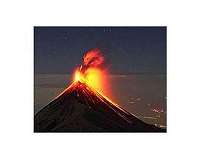
A live volcano whose increased activity this week near Guatemala's capital — causing ash columns in the sky, explosions and tremors — sparked an alert subsided on Wednesday, emergency response officials said.
"The eruption of Fuego Volcano has diminished considerably… and this Wednesday it presented a relatively weak explosion considered within normal parameters," a spokesman for the Disaster Reduction National Coordination Committee, David de Leon, told reporters.
The 3,763-meter (12,346-foot) high volcano is located 50 kilometers (30 miles) southwest of Guatemala City.
On Tuesday, officials had declared an orange alert because of the increased activity noted since the day before, which showered fine ash over at least six villages and on the town of San Pedro Yepocapa, in the indigenous province of Chimaltenango. A nearby hotel was evacuated.
De Leon said authorities from the health and agriculture ministries were monitoring the area for possible respiratory problems and damage caused by the ash.
In February, the volcano erupted with such force and so much ash that Guatemala was forced to close the airport serving its capital.
Guatemala and neighboring countries lie on what is known as the Central American Volcanic Arc, a chain of hundreds of volcanoes that forms part of the Pacific "Rim of Fire."
Most are dormant, but some spectacular — and dangerous — eruptions do happen.
Guatemala issues orange alert over erupting Fuego Volcano
Guatemala City (AFP) Nov 10, 2015 – Emergency service officials in Guatemala on Tuesday issued an orange alert over increasing eruptions from the country's southeastern Fuego volcano and ordered the evacuation of a nearby hotel.
The 3,763-meter (12,346-foot) high colossus — whose name means "fire" in Spanish — showed heightened activity overnight, sending columns of ash high into the sky, spilling lava down its side and provoking small tremors.
Fine ash was falling on at least six villages and on the town of San Pedro Yepocapa, in the indigenous province of Chimaltenango, a state spokesman for the Disaster Reduction National Coordination Committee, David de Leon, told reporters.
The country's Seismology and Vulcanology Institute urged authorities to consider taking precautionary measures for air traffic.
Thick, airborne ash can clog planes' engines and cause them to fail. In February, the volcano erupted with such force and so much ash that Guatemala was forced to close the airport serving its capital.
Guatemala and neighboring countries lie on what is known as the Central American Volcanic Arc, a chain of hundreds of volcanoes that forms part of the Pacific "Rim of Fire". Most are dormant, but some spectacular — and dangerous — eruptions do happen.
The Fuego volcano lies near Guatemala's colonial-era city of Antigua Guatemala and is about 40 kilometers (25 miles) southwest of the capital Guatemala City.
Strong 6.9-magnitude quake hits Chile: USGS
Washington (AFP) Nov 11, 2015 –
A strong 6.9-magnitude earthquake struck off the coast of central Chile late Tuesday but there was no immediate tsunami alert or reports of injuries or damage, US seismologists said.
The epicenter of the quake was near the coast, about 93 kilometers (57 miles) northwest of Coquimbo, said the US Geological Survey (USGS). It initially gave the magnitude as 6.6.
The Pacific Tsunami Warning Center said there was no tsunami threat from the quake, which struck at 8:54 pm (0154 GMT Wednesday) at a depth of 10 kilometers.
Chile's National Emergency Office said there were no reports of harm to people or any disruption to basic services or infrastructure.
The quake was felt in the regions of Atacama and Coquimbo, in particular in the city of La Serena.
Images on Chilean television showed empty streets in La Serena. No damage to buildings or houses were reported and traffic remained normal.
Less than an hour later, a 6.8-magnitude aftershock rattled the same region.
Also centered off the coast some 97 kilometers west-northwest of Coquimbo, it hit at 0246 GMT Wednesday, again at a depth of 10 kilometers.
Chile is no stranger to earthquakes.
In September, the same area of the country was hit by an 8.3-magnitude earthquake and tsunami that left 15 dead and over 16,000 homeless.
In February 2010, an 8.8-magnitude quake off the southern Chilean coast killed more than 500 people and inflicted an estimated $30 billion in damage.
Chile lies on what is known as the "Ring of Fire" — an arc of fault lines that circles the Pacific Basin and is prone to frequent earthquakes and volcanic eruptions.
