
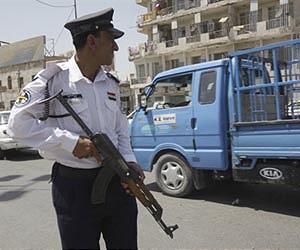
Shortfalls in the capabilities of Iraq's security forces could undo security gains after US troops leave at the end of 2011, a US watchdog said in a report published Sunday.
The Special Inspector General for Iraq Reconstruction (SIGIR) noted that while Baghdad's forces had made major improvements, they suffered from poor logistics capabilities, and that corruption within the police and army had hampered their development.
"This quarter, several US observers noted real or potential gaps in Iraqi Security Forces (ISF) capabilities that could affect its ability to lock in hard-won security gains," SIGIR said in its quarterly report.
It noted that according to US department of defence assessments, "both MOI (ministry of interior) and MOD (ministry of defence) security forces are behind in the attainment of Minimum Essential Capability."
Minimum Essential Capability refers to a standard that indicates that forces "can provide internal security and possess foundational capabilities to defend against external threats."
Violence in Iraq declined as 2010 went along, with the number of deaths from attacks dropping for six consecutive months from July, though an apparent spike in insurgent activity in the past two weeks appears to have broken this trend.
All American soldiers must leave Iraq by the end of 2011, per the terms of a bilateral security pact.
The SIGIR report noted that the Iraqi army "appears likely to fall short" in terms of logistics capabilities by the time US troops leave.
It added interior ministry forces "are expected to have gaps in funding, command and control, and logistical infrastructure through the time USF-I withdraws."
Meanwhile, the American training mission in Iraq told SIGIR that "corruption within the ISF has hindered development and led to the inefficient allocation of human and fiscal resources, as well as the absence of a requirements-driven planning process for the maintenance of security infrastructure and equipment."
American forces told the watchdog that the US "faces the choice of making additional investments to fill essential gaps in ISF capabilities or accept the risk that they will fall short of being able to fully secure Iraq from internal and external threats by the time US forces depart."
While US commanders in Iraq insist their local counterparts are able to maintain security within the war-ravaged country, the Iraqi army chief of staff Babaker Zebari told AFP in August that Baghdad's forces would need American help until 2020.
A spokesman for US forces in Iraq, Colonel Barry Johnson, said the SIGIR report echoed the military's own views.
"We have been forthright about the areas of concern and this report only reinforces what we've already said many times," Johnson said.
"Much of our focus in the months ahead includes developing the Iraqi forces' critical capabilities in logistics and sustainment, intelligence gathering and integration, leadership development, and defense against external threats."
Johnson added that development of those capabilities would continue after US forces withdrew from Iraq and the US State Department takes over responsibility for security force training.
earlier related report
Iraq forces on alert after Baghdad blasts kill 53
Baghdad (AFP) Jan 28, 2011 – Iraqi security forces were on alert Friday after a massive car bomb ripped through a funeral ceremony in a Shiite district of Baghdad, killing 48 people in Iraq's bloodiest day in more than two months.
The blast on Thursday was the deadliest in a series of bombings that claimed 53 lives across the capital, and led to an angry crowd pelting security forces with stones when they arrived at the scene.
It was the latest in a surge in violence in the past 10 days that has left more people dead than attacks throughout any of the past three months, and comes little more than a month after Prime Minister Nuri al-Maliki formed a coalition government, ending the deadlock that followed March elections.
"The government arrests terrorists, they send them to prison, and then they release them the next day," shouted Abu Mohammed Saadi, 56, one of the funeral-goers.
"Take the criminals off the streets, don't release them so quickly!"
An interior ministry official said the car bomb, which exploded outside a tent where the ceremony was being held early afternoon in the Shuala neighbourhood, killed 48 people and wounded 121.
Saadi and other witnesses said the car bomb was driven by a suicide attacker.
The blast caused part of the tent to collapse and left pools of blood and scattered pieces of clothing and shoes.
Several cars were also completely destroyed, while the windows of nearby homes were shattered. Security forces closed off many of the main roads leading to the blast site and imposed a vehicle curfew.
Policemen and soldiers who rushed to the scene were confronted by an angry mob that assaulted them with volleys of stones, with the security forces initially retreating from the scene.
The interior ministry official said that "armed men" had fired on the forces who arrived at first, causing the soldiers and policemen to withdraw until another army regiment arrived.
But a witness at the scene, Hussein Mohammed Saadi, said that the crowd had become furious after the arrival of the first security force officer at the scene. Saadi said the officer played down the attack and accused members of the crowd of having planted the bomb.
Maliki ordered the arrest of the area's security chief, army Lieutenant Colonel Ahmed al-Obeidi, in the immediate aftermath of the attack.
In other blasts around the capital on Thursday, five people were killed and 21 wounded by roadside bomb attacks and a bomb placed inside a minibus.
The overall death toll of 53 was the highest for Iraq since November 2, when 11 car bombs rocked the capital, killing 63 and wounding nearly 300 in predominantly Shiite neighbourhoods.
The funeral attack was the latest targeting Shiites since a spate of car bombings last week killed 57 people outside the shrine city of Karbala.
Those bombings came ahead of a Shiite mourning ritual when hundreds of thousands of pilgrims poured into the city to mark 40 days after the Ashura anniversary commemorating the slaying of Imam Hussein, the sect's revered seventh century saint.
On January 20 on the outskirts of Karbala, three car bombs exploded among crowds of worshippers around 20 minutes apart, killing 45 people and wounding 150 others.
Another triple car bombing four days later killed 12 and wounded dozens.
Imam Hussein's death at a battle near Karbala is at the heart of the historical division between Islam's Sunni and Shiite sects.
The split has fuelled sectarian violence between Iraq's Shiite majority and the Sunni Arab minority that dominated Saddam Hussein's regime until its ouster in the US-led invasion of 2003.
Also last week, Al-Qaeda's front group in Iraq claimed responsibility for a series of suicide bombings north of Baghdad that cost more than 60 lives.
Violence across Iraq since a suicide bomber blew himself up in the middle of a crowd of police recruits in Tikrit on January 18 has already killed more people — at least 192 — than in October, November or December, when 185, 171 and 151 people died, respectively.
Share This Article With Planet Earth
