
Germany in the past five years more than doubled the volume of its arms sales and is now Europe's largest weapons exporter, a new study states.
Germany's global market share jumped to 11 percent during the 2005-09 period, up from 6 percent at the start of the millennium, data released this week by the Stockholm International Peace Research Institute indicate.
That means Germany shot to become the world's third-biggest weapons exporter, passing by the once-thought-untouchable military industry powerhouses France and Britain, which came in at rank Nos. 4 and 5, respectively.
The United States and Russia are still the biggest arms exporters, with more than half of all sales shared between them. U.S. companies from 2005-09 sold arms to 70 countries — more than any other nation.
In Europe, the dynamics seem to be shifting. While France increased its sales by around 30 percent, British arms exports dropped 13 percent.
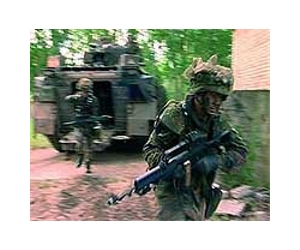
The German export boost was fueled mainly by the popularity of German-made submarines and armored vehicles.
Krauss-Maffei Wegmann and Rheinmetall build tanks and armored vehicles, with German shipyards owned by ThyssenKrupp Marine Systems developing submarines and ships that have been sold all over the world.
On a global scale, fighter jets dominate the arms trade — they account for 27 percent of total sales. SIPRI, a Swedish peace research institute, warns that increasing jet sales to the Middle East, Asia and Latin America are destabilizing peace in those regions.
"SIPRI data show that resource-rich states have purchased a considerable quantity of expensive combat aircraft," said Paul Holtom, head of the arms transfers program at SIPRI. "Neighboring rivals have reacted to these acquisitions with orders of their own. One can question whether this is an appropriate allocation of resources in regions with high levels of poverty."
SIPRI is warning of selling combat arms in unstable regions.
While the United States sold one-third of its arm exports to South Korea, Israel and the United Arab Emirates, more than half of Russian exports went to China and India.
The Asian market has been highly active recently, with five of the 10 largest importers for 2005-09 being Asian states — China, India, South Korea, Singapore and Pakistan.
For the southeastern part of the continent, SIPRI experts warn of a dangerous arms race.
"In 2009, Vietnam became the latest Southeast Asian state to order long-range combat aircraft and submarines," said SIPRI's Asia expert Siemon Wezeman. "The current wave of Southeast Asian acquisitions could destabilize the region, jeopardizing decades of peace."
Weapons sales to Latin America were 150 percent higher during the last five years compared to the beginning of the millennium, following a significant upswing in both military spending and an almost competitive behavior when ordering arms, SIPRI found.
"This clearly shows we need improved transparency and confidence-building measures to reduce tension in the region," said Mark Bromley, SIPRI's Latin America expert.
SIPRI has been compiling data on the international arms trade since the 1950s. Its online database is the most extensive available to the public.
Share This Article With Planet Earth
