
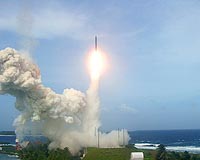
The defining characteristic of ballistic missiles is that they employ a powerful boost from rocket engines to launch them on their trajectories, after which they coast to their intended destinations. Although the trajectory is predictable, it is traversed so quickly that interception is impossible using conventional weapons.
For instance, an intercontinental ballistic missile may move at several miles per second, much faster than any other target that U.S. forces are equipped to counter.
Experts distinguish four categories of ballistic missiles, based on their range:
— Short-range missiles that can reach as far as 600 kilometers (360 miles).
— Medium-range missiles that can reach from 600 to 1,300 kilometers (360 to 780 miles).
— Intermediate-range ballistic missiles that can reach 1,300 to 5,500 kilometers (780 to 3,300 miles).
— Intercontinental-range ballistic missiles that can reach 5,500 to 10,000 kilometers (3,300 to 6,000 miles).
Weapons with longer ranges typically move faster than those with shorter ones, and therefore are harder to intercept. They also typically have larger payloads, with some carrying 10 or more warheads.
In general, the farther a ballistic missile can reach, the more military options and political prestige it provides to its owner. For example, a short-range missile launched by North Korea cannot hit far beyond the Korean Peninsula, but a medium-range missile can hit most of Japan, an intermediate-range missile can hit Taiwan, and an intercontinental-range missile can hit much of the United States.
The power associated with possessing such options is a key reason why countries like Iran and North Korea expend so much effort pursuing ballistic-missile technology. No other class of weapons confers so much military stature on a nation.
A recent study by the Center for American Progress found the number of medium- and intermediate-range missiles in global arsenals has declined by 80 percent since the closing days of the Cold War and that the number of intercontinental-range missiles has declined by about 70 percent.
These declines demonstrate that when political conditions permit arms reduction, it is feasible to reduce the ballistic-missile threat to the United States and its allies without investing in elaborate defensive schemes. However, the study also found that during the same period some major powers were paring their arsenals, five countries developed new medium-range missiles, and three of those countries — Iran, North Korea and Pakistan — were newcomers or aspirants to the nuclear weapons club.
The spread of ballistic-missile technology has followed a classic proliferation pattern.
—
(Part 4: How ballistic missile defenses can prove effective deterrents against the limited ballistic missile arsenals of many nations around the world.)
(Loren B. Thompson is chief executive officer of the Lexington Institute, an Arlington, Va.-based think tank that supports democracy and the free market.)
(United Press International's "Outside View" commentaries are written by outside contributors who specialize in a variety of important issues. The views expressed do not necessarily reflect those of United Press International. In the interests of creating an open forum, original submissions are invited.)
