
The US is expected to lose some $5 billion if Russia goes ahead with the idea of halting delivery of rocket engines used to launch American defense satellites. American military experts counted the cost after Russian Vice President Dmitry Rogozin and head of the Roscosmos space agency Oleg Ostapenko hinted last week that supplies of the RD-180 engines might not continue.
Calculations came from a group of experts led by retired Air Force General Mitch Mitchell and former NASA administrator Michael Griffin, assessing the implications of a Russian ban.
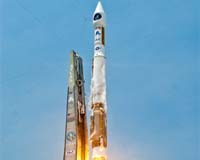
Engines have been delivered to the United States from the Energomash plant at Khimki, north of Moscow. They are used to launch Atlas-5 carrier rockets designed by Lockheed-Martin Corporation for military projects.
Reviewing project plans, the American experts warned in their report that while 38 Atlas launches were slated for coming years, only 16 Russian rockets were currently available.
According to the most optimistic scenario, at least nine launches would be delayed due to engine shortages in the next two years, entailing losses of $2.5 billion. In the worst case scenario 31 launches will be thwarted within three-and-a-half years at a cost of some $5 billion.
The report authors say the US Defense Department should buy more rocket engines in Russia now, enlarging their stockpile to a maximum. These proposals have been confirmed by Energomash director Vladimir Solntsev, telling ITAR-TASS that the United States sought to increase engine deliveries by 2018 to 37 units instead of the planned 29.
Replacement of Russia's RD-180 rocket engine may cost US $1.5 bln and six years to develop
The development of a rocket engine to replace Russia's RD-180 used by US Atlas-5 space launch vehicle may cost the United States $1.5 billion and will take as long as six years, the Bloomberg news agency reports, citing a team of Pentagon advisors.
An independent advisory panel warned the US Department of Defense that the loss of RD-180 would have "significant effects" and as "near-term options to mitigate them are limited", it said, action must be taken by the end of September to "mitigate current risk and preserve" options.
Despite the Pentagon's assurances that it has a two-year inventory of RD-180s, the panel fears a halt in RD-180 supplies may delay the launch of military payloads and increase costs by as much as $5 billion beginning in 2017.
Earlier, Defense Secretary Chuck Hagel ordered the Air Force to revise the principles of military-technological cooperation with Russia to reduce America's dependence on Russian rocket engines.
Meanwhile, according to US Under Secretary of Defense for Acquisition Frank Kendall, the US has nothing to substitute for the Russian-made engines it uses to launch its military satellites. So it needs to either create a domestic analogue of the RD-180 or totally abandon Atlas and switch to the Delta launch vehicle using a different type of engine.
Russian Deputy Prime Minister Dmitry Rogozin said in Moscow on May 13 that Russia may cut off supplies of RD-180s to the United States in response to US sanctions against Russia over Ukraine.
Replacing Russian-made rocket engines is not easy-Pentagon
The Pentagon is hard-pressed to find a replacement for the Russian-made rocket engines it buys, a senior official has revealed. The import of the engines has for now been banned via a court order lobbied by SpaceX and based on sanctions imposed on Russia during the Ukrainian crisis, Stars and Stripes reports. The private space exploration company SpaceX says it has a cheaper way to launch satellites, and was suing the US Air Force for the chance to prove it.
US billionaire Elon Musk's SpaceX on Wednesday won a court order temporarily blocking the Air Force from buying the Russian rocket engines on the grounds of a "potential violation" of US-imposed sanctions. The corporation says that by purchasing the engines, the Air Force is funneling money to Russia's military industrial complex, which could be sponsoring some sanctioned Russian figures.
US Congress presents bill to ban Russian arms, Pentagon opposes move
Thursday, a bill aimed at curtailing current contracts with the Russian company Rosoboronexport and prohibiting the conclusion of new agreements with it was introduced to the Senate of the US Congress. The document is called the "Embargo Act on Russian Arms of 2014."
The authors of the bill – Senators Dan Coats, John Cornyn and Richard Blumenthal have emphasized that their goal was to increase pressure on Russia in the light of the recent events in Ukraine. Their initiative also prohibits signing of contracts with any US or foreign companies cooperating with the Russian arms exporter.
Source: Voice of Russia
