
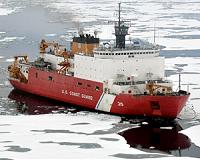
The United States is totally unprepared to take part in the mounting competition for the riches of the Arctic as it lacks the primary means to do that, namely icebreakers, Newsweek reported. Conducting major research, carrying out a search and rescue operation or escorting other ships through the treacherous sea ice in the Arctic is unimaginable without this type of vessel.
Russia has long understood the opportunities the region offers. In the past few years the country has been actively developing its northern territories, engaging in oil and gas extraction and exploring the Northern Sea Route, which is now seen as an alternative to traditional links between Europe and Asia.
Hence, Russia has a choice of 27 polar icebreakers and it is building new ones, with some of them being nuclear-powered. Russia is the only country building nuclear-powered icebreakers, which are considerably more potent than the diesel-powered ones. The United States operates two icebreakers, the USCGC Polar Star (WAGB-10) and the USCGC Healy (WAGB-20), and only one of them is sent on missions to the Arctic.
The Polar Star commissioned in the late 1970s was reactivated in 2013 after a nearly $60-million overhaul and is currently assigned to operations in the Antarctic. Despite the efforts to revive it, the ship has long outlived the intended three-decade lifespan and is expected to be decommissioned by 2020.
The USCGC Healy (WAGB-20) commissioned in 1999 takes part in scientific research operations in the Arctic but it cannot access all corners of the region due to its size.
Building icebreakers takes time and could cost up to a billion dollars, which no one in the United States is willing to pay, the American weekly news magazine observed. The 2016 budget of the US Coast Guard, which operated the icebreakers, slightly exceeds $1 billion.
But the cost does not stop other nations from building these ships. Canada, Finland and Sweden operate more icebreakers than the US. Even China, by no means an Arctic nation, has two of those.
The Arctic is believed to hold enormous deposits of energy resources. According to a US Geological Survey (USGS) report, some 13 percent of all undiscovered oil on the planet and up to 30 percent of all natural gas lies in the region. But the Artic also boasts large deposits of coal, copper, diamonds, gold, iron, nickel, tungsten and uranium.
Therefore, the Arctic invites "a new kind of geopolitical cold war and the US is in danger of losing," Newsweek wrote, citing US Coast Guard Commandant Paul F. Zukunft, who said that Washington is "not even in the same league as Russia right now. We're not playing in this game at all." The US lack of involvement in the Arctic could be partially explained by the fact that the country did not understand how significant the region is.
In June, US Defense Secretary Ashton Carter observed: The Arctic "is a going to be a major area of importance to the United States strategically and economically in the future. I think it is fair to say we are late to the recognition of that, but I do think we have the recognition."
