
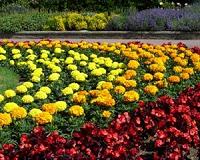
Heat plays an important role in flower-pollinator interactions. According to new research, heat patterns serve as signatures for flowers, advertising their availability to passing bees.
When scientists at the University of Bristol analyzed the dispersion of heat across the petals of common garden flowers, like poppies and daisies, they found heat patterns reflect the visual patterns produced by the colored pedals. Researchers also found the heat patterns were an average of 4 to 5 degrees Celsius warmer than other parts of the flower.
To determine the influence of petals' heat patterns on pollinator behavior, researchers designed artificial flowers with heat patterns mimicking real flowers. The fake flowers had no visual patterns.
While the flowers all looked the same to the human eye, lab tests involving bumblebees proved pollinators can use the heat pattern signature to tell the flowers apart. The patterns helped bees choose the flowers most likely to offer the most nectar.
Researchers shared the results of the artificial flower experiment in a new paper published this week in the journal eLife.
"The presence of multiple cues on flowers is known to enhance the ability of bees to forage efficiently, so maximizing the amount of food they can take back to sustain the rest of their colony," Bristol researcher Heather Whitney said in a news release. "Climate change might have additional previously unexpected impacts on bee-flower interactions by disrupting these hidden heat patterns."
Previous studies have shown that bees prefer warmer flowers, especially on cool days. In some cool forests, bees' preference for warmer, dark-colored petals is influencing flower evolution.
How much soil goes get washed down the drain
According to a new study by the University of Basel, the European Commission – Joint Research Centre and the Centre for Ecology and Hydrology (CEH, UK), almost 36 billion tons of soil is lost every year due to water, and deforestation and other changes in land use make the problem worse. The study also offers ideas on how agriculture can change to become a part of the solution from being part of … read more
