
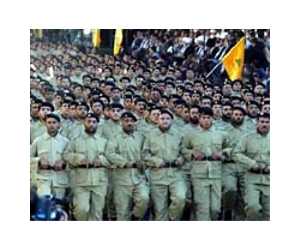
The U.N. special tribunal investigating the 2005 assassination of former Prime Minister Rafik Hariri has raised political tensions in Lebanon, already fearful that a new war with Israel is looming, by questioning a dozen members of Hezbollah.
The Iranian-backed Shiite movement denies involvement in the bombing in Beirut that triggered a wave of assassinations against Lebanese critics of Syria, Hezbollah's ally.
Hezbollah Secretary-General Hassan Nasrallah has branded the tribunal's focus on his organization as a U.S. plot and warned the movement wouldn't "stay silent" if investigators implicate it in the assassination.
"Accusing individual members of our party is equivalent to accusing Hezbollah," he declared Wednesday. "That would take Lebanon to a very difficult place."
There is an uneasy calm in Lebanon these days despite the friction between Hezbollah and its political rivals, led by Hariri's son Saad, the current prime minister. Implicating Hezbollah in the assassination could plunge the nation into turmoil again and heighten the prospect of war.
The focus on Hezbollah by the special tribunal, which was established in The Hague, capital of the Netherlands, in March 2009, has marked a sharp change in direction for the investigation that was initiated by the United Nations shortly after Hariri's assassination Feb. 14, 2005.
Its main thrust initially involved Syria, which from the start was widely seen as the culprit, along with its proxies in Lebanon's security services.
Hariri, a billionaire tycoon, became prime minister in 1992 with the blessing of Syria, which had dominated Lebanon since its 1976 military intervention during the civil war. But 12 years later he had fallen out with Damascus over its ruthless control of political life and the imposition of its surrogates in the presidency, parliament and the security services.
The Shiite Hezbollah, Syria's principal Lebanese ally, possesses the intelligence and military apparatus capable of undertaking the kind of elaborate operation that killed Hariri, a Sunni.
But it was never seriously considered to have been implicated until the German newsweekly Der Spiegel reported in May 2009 that U.N. investigators believed Hezbollah was the guilty party.
Der Spiegel said the killing was carried out by a "special operational unit" headed by Hajj Salim, a top military commander. The unit, it said, reported directly to Nasrallah. The magazine concluded that Hezbollah was unhappy with Hariri's growing popularity and with his close alliances with the West.
The tribunal has never commented on Der Speigel's claims and there has been no official explanation for the seemingly abrupt new tack in its investigation.
The identity and seniority of those questioned hasn't been disclosed by either party. But the mere fact Hezbollah has entered the frame has fueled speculation of political skulduggery.
Nasrallah has long maintained that the investigation and tribunal to try the suspected assassins had been heavily politicized and to a large extent that has been true.
Initially, the first head of the U.N. investigation, veteran German prosecutor Detlev Mehlis, bluntly pointed the finger at the Syrian regime and in particular its military intelligence service, which controlled Lebanon with a heavy hand. The Syrians have denied involvement.
There are no suspects in custody. Four Lebanese generals imprisoned as suspects on Mehlis' orders in August 2005 were released last year on grounds there was no evidence to hold them — an anomaly that has yet to be fully explained.
The release was a major setback for those who contend Syria was behind Hariri's assassination to maintain their control of Lebanon.
The administration of U.S. President George W. Bush was quick to exploit the tidal wave of anti-Syrian sentiment that followed Hariri's assassination. But the administration of President Barack Obama has sought to re-engage with Damascus in hopes of prying it away from its 30-year alliance with Iran.
Since Mehlis resigned in 2006, there has been a marked reluctance by his two successors as head of the investigation to even mention Syria as a suspect.
This has been attributed by many in Lebanon to U.N. reluctance to hold an internationally recognized government responsible for the Hariri assassination and the implications that would have for other autocratic or totalitarian regimes friendlier to the West, such as Saudi Arabia and Egypt.
Share This Article With Planet Earth
