
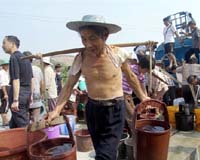
Nearly five million Chinese are unable to get enough drinking water because of a series of droughts caused by "abnormally high" temperatures, state media said Sunday. Crucially in a nation which still relies on agriculture for the majority of its people, the drought is also cutting off sufficient water supplies for 2.5 million livestock, the Xinhua news agency reported.
One of the worst hit regions is Shandong province in east China, which is China's second-most populous with 92 million and one of the nation's main grain producers, according to the agency.
Xinhua quoted statistics from Shandong Provincial Meteorological Observatory that from September to February, the province received just 51.4 millimetres (two inches) of rain, down 80 percent from a year earlier.
One fifth of the total farmland in the province is short of water, and out of this portion, according to Xinhua.
Sichuan province in southwestern China, another key area for agricultural production, has also experienced unusually high temperatures, leaving 1.1 million people without enough water, Xinhua said.
In Chongqing, a municipality to the east of Sichuan, access to drinking water will be a problem until the flood season starts in May, according to the agency.
Southern Chinese Province Tries To End Water Waste
Beijing (AFP) Feb 27- China's booming southern province of Guangdong plans to drive up the cost of water for its 92 million residents in an effort to cut rampant wastage, state press reported Tuesday. Households in the provincial capital of Guangzhou will from Thursday have to pay extra if they use more than 210 litres (55 gallons) of water a day, the China Daily reported, citing the province's Bureau of Water Conservancy.
A 10-minute shower uses 20 gallons (75 litres) of water, according to the US Geological Survey's environment educational website.
Under a three-tier structure, households using more than 30 cubic metres (1,050 cubic feet) of water a month will have to pay 2.64 yuan (34 cents) a cubic metre, double the standard price.
The fees have been introduced as Guangzhou's per capita water consumption is 2.3 times more than the world's average, and three times higher than in Paris, the China Daily reported.
"Most families will not have to pay extra … provided they don't waste water," the China Daily quoted the general manager of the Guangzhou Tap Water Company, Shen Shiquan, as saying.
Water premiums and quotas had also been set for industrial and agricultural uses in Guangzhou, while fees in other cities throughout Guangdong would also rise, the newspaper said, although the prices were not given.
Water is becoming an increasing concern for policymakers throughout China as the nation of over 1.3 billion people grows wealthier, placing ever-more strain on limited natural resources.
The official Xinhua news agency reported last week that the central government was making plans to cut average water consumption by 20 percent by the end of 2010.
The government intended to set up consumption quotas and make local officials responsible for managing the use of water, Xinhua said, citing the ministry of water resources.
China only recycles 60 to 65 percent of its industrial water, compared with 80 to 85 percent in developed countries, Xinhua said.
Source: Agence France-Presse
