
Protesters calling for full democracy in Hong Kong vowed Thursday to ratchet up their occupation of key parts of the city if they fail to win concessions from the government ahead of crunch talks tomorrow.
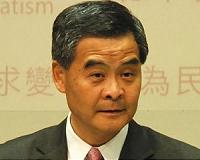
The threat was issued as the city's embattled leader came under pressure to explain why he kept large payments from an Australian company secret with pro-democracy lawmakers saying they would try to impeach him.
Parts of the vital financial hub have been paralysed for more than a week by demonstrations calling for Beijing to grant the former British colony full democracy and for the city's Chief Executive Leung Chun-ying to resign.
Under plans unveiled by China in August, Hong Kongers will be able to vote for Leung's successor in 2017, but only two to three vetted candidates will be allowed to stand.
Although protester numbers have dwindled in recent days, small groups still control multiple barricades across the city in what has become the most concerted challenge to Beijing's rule since Hong Kong's handover in 1997.
In a show of unity Thursday evening, a coalition of pro-democracy leaders gathered at the main protest site and vowed to ratchet up their civil disobedience campaign unless the government agreed to their demands.
Students are due to meet Leung's deputy Carrie Lam on Friday afternoon in bid to break the deadlock.
But Alex Chow, president of the Hong Kong Federation of Students, said pro-democracy protesters would remain on their barricades — and could expand their occupation — if the talks broke down.
"Hong Kong people will not retreat. And there's no reason for anyone to ask us to retreat. Therefore the Occupy movement must be ongoing," he said.
"Also the students will go into different occupy areas," to discuss potential future plans for further civil disobedience, he added.
– Lawmakers vow disruption –
Pro-democracy lawmakers also threw their weight behind the protests Thursday saying they would use their powers to disrupt the workings of the Hong Kong government inside the city's parliament by gridlocking the committees they they currently control.
"Hong Kong has entered an era of disobedience and non-cooperation," pro-democracy leader Alan Leong told crowds.
His call came as lawmakers accused the city's leader of having a "huge integrity problem" for failing to declare a lucrative windfall of cash from business dealings in Australia.
Fairfax Media reported Wednesday that Leung received two payments totalling HK$50 million ($6.5 million) from Australian engineering firm UGL during a deal struck in December 2011 — months before the chief executive took office, but a week after he announced his candidacy.
At the time UGL was purchasing the insolvent property services firm DTZ, where Leung was a director and chairman of its regional operations.
It agreed to pay Leung over the next two years not to compete with them, and the contract signed by him showed he agreed to act as an "adviser from time to time".
Opposition lawmakers Thursday expressed their dismay that Leung did not declare the payments to the Hong Kong public once he became leader in July 2012.
"It boils down to a huge integrity problem," pro-democracy lawmaker Claudia Mo told AFP. "Can you imagine Obama being a consultant of some company while being a political leader?"
Leung's office has said he was under no legal obligation to declare the earnings and that he had not worked for UGL since becoming chief executive.
Pro-democracy lawmaker Leong said his group of 23 lawmakers in the 70-seat body were planning to file an impeachment order against the chief executive following the emergence of the deal.
"We are gathering the evidence and working on the draft. We will move the motion in the Legco when the draft is ready," Leong said.
US must keep close watch on Hong Kong, panel finds
Washington (AFP) Oct 09, 2014 –
Pro-democracy protestors in Hong Kong won powerful backing Thursday from a US government panel, which urged Washington to return to keeping a close eye on the city, including with high-level official visits.
The call came in a damning annual report that renewed criticism of China's human rights record, saying President Xi Jinping continues to "adhere to the authoritarian model of his predecessors."
In a highly-critical and unusual rebuke over Hong Kong, the government commission found that Beijing's actions in recent months to restrict democracy there "raise concerns about the future of the fragile freedoms and rule of law that distinguish Hong Kong from mainland China."
It called on Congress and the Obama administration to revive a 1992 law — drawn up five years before the financial hub was returned to Chinese rule by Britain — under which the State Department had to furnish annual reports on the situation in Hong Kong.
Parts of the southern Chinese city have been paralyzed for more than a week by demonstrations calling for Beijing to grant the former British colony full democracy and for the city's Chief Executive Leung Chun-ying to resign.
Talks between the protestors and the Hong Kong government collapsed Thursday, plunging the city into a fresh crisis.
US monitoring should "pay particular attention to the development of democratic institutions in Hong Kong and China's obligations under international treaties and agreements," the Congressional-Executive Commission on China recommended.
The move, which comes just ahead of next month's official visit to China by President Barack Obama, is likely to spur fresh fury in Beijing, which last week angrily warned Washington to stay out of its "internal affairs."
The panel also demanded that US lawmakers and the Obama administration "should increase support for Hong Kong's democracy" with meetings "at the highest levels and visits" to the city.
The last visit to the city by a US secretary of state was by Hillary Clinton in July 2011.
The panel found Beijing's stance over Hong Kong, as well as its crackdown on any opposition, suggested that Xi "may exercise greater control and tolerate less dissent than previous administrations."
It also highlighted government restrictions on the Internet and attempts to "manipulate news coverage" as well as concerns over forced labor, making 13 recommendations to ensure China complies with international human rights and the development of rule of law.
The report further called for US lawmakers to urge the Chinese government to "abolish all birth restrictions for families and instead employ a human rights-based approach to providing freedom to build their families."
