
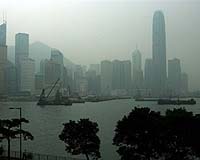
Street-level air pollution in Hong Kong's busiest districts has soared over the past four years, official data has shown, despite a government campaign to curb vehicle emissions in the Chinese city.
The government recorded a total of 1,066 hours of "very high" air pollution, equal to more than 44 days, in three main city districts in the first half of 2009 — a sixfold jump compared to the same period in 2005.
The number of such hours recorded above street level in the same districts however dropped by more than half over the same period, the data showed.
The pollution index is based on the concentration of sulphur dioxide, nitrogen dioxide, ozone, and respirable suspended particles in the air. A "very high" rating prompts a health alert to those with heart and breathing problems.
Pollution has in recent years become an increasing health and economic headache for the authorities in Hong Kong.
Emissions from the factory belt in southern China over the city's northern border combined with local emissions from power plants and transport to generate a thick haze over the city for large parts of last year.
The government has stepped up efforts to cut vehicle emissions, including offering tax concessions to users of environmentally-friendly hybrids.
The city's Environmental Protection Department said in a statement that comparing the pollutant concentrations over a few years would not provide a full picture.
It said between 1999 and 2008, the roadside concentrations of sulphur dioxide, nitrogen dioxide, and respirable suspended particles had each dropped by about a fifth.
Chan Chak-keung, a professor of chemical and biomolecular engineering at Hong Kong University of Science and Technology, told AFP the trend signalled the need for a more comprehensive policy to clean up the air.
"The government has made significant effort in reducing vehicular emissions. However, we also need to revamp policies on urban planning and public transportation services," he said.
A change in wind direction and the closure of factories in neighbouring Guangdong province due to the economic downturn could explain the improvement in air quality above street level, Chan said.
Share This Article With Planet Earth
