
The Milky Way is a spiral galaxy, a disc-shaped island of stars in the cosmos, in which most bright and young stars cluster in spiral arms. There they form from the dense interstellar medium (ISM), which consists of gas (especially hydrogen) and dust (microscopic grains with high abundances of carbon and silicon). In order for new stars to form continuously, material must be constantly flushed into the spiral arms to replenish the supply of gas and dust.
A group of astronomers from the University of Calgary in Canada, the Max Planck Institute for Astronomy (MPIA) in Heidelberg and other research institutions have now been able to show that the supply comes from a much hotter component of the ISM, which usually envelops the entire Milky Way.
This warm ionized medium (WIM) has an average temperature of 10,000 degrees. High-energy radiation from hot stars causes the hydrogen gas of the WIM to be largely ionised. The results suggest that the WIM condenses in a narrow area near a spiral arm and gradually flows into it while cooling.
The scientists discovered the dense WIM by measuring the so-called Faraday rotation, an effect named after the English physicist Michael Faraday. This involves changing the orientation of linearly polarised radio emissions when they pass through a plasma (ionised gas) traversed by a magnetic field. One speaks of polarised radiation when the electric field oscillates in only one plane. Ordinary light is not polarised. The magnitude of the change in polarisation also depends on the observed wavelength.
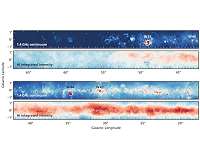
In the present study, recently published in The Astrophysical Journal Letters, astronomers were able to detect an unusually strong signal in a rather inconspicuous area of the Milky Way, which is located directly on the side of the Sagittarius arm of the Milky Way facing the galactic centre.
The spiral arm itself stands out in the imaging data due to strong radio emission generated by embedded hot stars and supernova remnants. However, the astronomers found the strongest shift in polarisation outside this prominent zone.
They conclude from this that the increased Faraday rotation does not originate within this active part of the spiral arm. Instead, it originates from condensed WIM, which, like the magnetic field, belongs to a less obvious component of the spiral arm.
The analysis is based on the THOR survey (The HI/OH Recombination Line Survey of the Milky Way), which has been conducted at MPIA for several years now and in which a large area of the Milky Way is observed at several radio wavelengths. Polarised radio sources such as distant quasars or neutron stars serve as "probes" for determining the Faraday rotation.
This allows astronomers not only to detect the otherwise difficult to measure magnetic fields in the Milky Way, but also to study the structure and properties of the hot gas. "We were very surprised by the strong signal in a rather quiet area of the Milky Way," says Henrik Beuther from MPIA, who is leading the THOR project.
"These results show us that there is still a lot to be discovered in studying the structure and dynamics of the Milky Way."
New insights into ancient collision between two galaxies
Newcastle UK (SPX) Jan 15 – A global research team, including Keele's Dr Barry Smalley, has revealed new insights about an ancient collision between our galaxy and another billions of years ago through the forensic analysis of a single star.
The investigation by Dr Smalley and his colleagues uncovered these new insights into the collision between the Milky Way and another smaller galaxy called Gaia-Enceladus early in its history, all thanks to the analysis of a single star visible from the southern hemisphere.
The international team of scientists analysed the bright star v Indi, located in the constellation of Indus, which enabled them to investigate the history of the wider galaxy.
Because stars such as v Indi carry 'fossilised records' of their histories, scientists are able to forensically characterise them to gather information about the wider galaxy and the environments the star formed in.
In this study, published in Nature Astronomy, the team used v Indi's natural oscillations to determine its age, using data from NASA's Transiting Exoplanet Survey Satellite (TESS) which was launched in 2018 to survey stars across the sky and any planets orbiting them.
This data, combined with information obtained by the European Space Agency's (ESA) Gaia mission, revealed that the star was born early in the Milky Way's life around 11.5 billion years ago, but its motion through the galaxy was altered when the Milky Way collided with Gaia-Enceladus.
Senior Lecturer in Astrophysics Dr Smalley said: "This exciting study, using observations from both space and ground-based observatories, has provided us with a more precise date of when the smaller Gaia-Enceladus galaxy was swallowed by the young Milky Way. While this occurred over 10 billion years ago, the evidence is still strewn across the night sky, allowing us to piece together events that happened early in the history of our Galaxy."
