
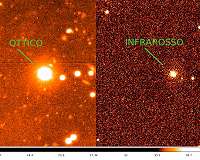
Finally the site where the supernova SN 2015J exploded was found by an international team of astronomers including Vincenzo Testa from INAF (the Italian National Institute of Astrophysics).
It is a happy ending story for SN 2015J, a supernova event so brilliant and peculiar but without any clear host galaxy. First observed on April 27, 2015, at the Siding Springs Observatory in Australia, it was classified as a supernova of type IIn, i.e., a rare object. However, the supernova address (or the galaxy within which it exploded) was missing, thus opening the possibility that SN 2015J was an "orphan" supernova.
These events could actually pop up in the middle of nowhere (away from galaxies) and possibly originated from massive stars at the end of their life cycle, expelled at great velocity from their original site. However, a natural explanation would be that the host galaxy was simply too small and faint.
To solve the case, a group of researchers, led by Achille Nucita (University of Salento and INFN section of Lecce) and attended by Vincenzo Testa from the Italian National Institute for Astrophysics (INAF) in Rome, organized an observational campaign that used the FORS2 camera mounted on the 8-meter-class VLT telescope of ESO and the IMACS (in the optical) and FourStar (near infrared) cameras mounted on the 6.5-meter Magellan telescope of the Las Campanas Observatory, in Chile.
The collected images have confirmed that SN 2015J has a home after all: it is located in what appears to be a very compact (about one-thirtieth of our own Milky Way) and faint galaxy.
"The fact that two important observatories as the ESO VLT in Paranal and the Magellan telescope (property of the Washington's Carnegie Institution) in Las Campanas gave us the requested observation time to pinpoint the host galaxy with their giant telescope demonstrates that the phenomenon was particularly interesting" says Testa.
"Thanks to these observations in the optical bands and near infrared, we finally identified the host galaxy that seems to be a dwarf galaxy with a faint disk and a brighter core in which SN 2015J exploded. Dwarf galaxies are of particular interest because we think they are the building blocks of larger galaxies. In this case, the galaxy is about 30 times smaller than the Milky Way, and in such objects it expected that such supernova events are rare."
Other interesting information about the supernova comes from the X-rays observations. At the time of the explosion, SN 2015J was observed by the Swift satellite with the XRT camera and, about one year after, again by Swift and the ESA XMM-Newton satellite. The XMM-Newton satellite in slew mode allowed the astronomers to identify (with just 7 seconds of total integration time), the X-rays coming from SN 2015J. The source, one year after the explosion, still showed a flux 30 times higher than the initial one.
Subsequent Swift/XRT observations showed that the source was active in X-rays and possibly among the brightest supernova events observed in X-rays. "X-ray observations pushed us to believe that SN 2015J was a IIn supernova," says Nucita, the first author of the article, describing the supernova survey published today on The Astrophysical Journal's website.
"If this hypothesis is confirmed, it would make SN 2015J very interesting. Honestly speaking, the light curve does not completely exclude a tidal disruption event – other similar cases have been observed in the past – and this makes this search even more interesting."
Astronomers reveal nearby stars that are among the oldest in our galaxy
Astronomers have discovered some of the oldest stars in our Milky Way galaxy by determining their locations and velocities, according to a study led by scientists at Georgia State University.
Just like humans, stars have a life span: birth, youth, adulthood, senior and death. This study focused on old or "senior citizen" stars, also known as cool subdwarfs, that are much older and cooler i … read more
