
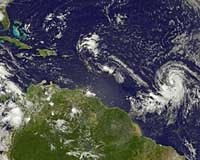
The first hurricane of the Atlantic storm season, Bill, strengthened Monday as it churned toward the US mainland, while another sizeable storm lost punch at landfall in Florida, weather officials said.
"Bill could become a major hurricane by Wednesday," and was likely to grow in intensity as it moved west-northwest at about 16 miles per hour (26 kilometers per hour) over the next couple of days, the Miami-based National Hurricane Center said.
At 2100 GMT, Hurricane Bill was churning in the middle of the Atlantic, 975 miles (1,570 km) east of the Lesser Antilles and packing sustained winds near 90 mph (150 kmh), it added.
Meanwhile, Tropical Storm Claudette, which lashed tourist resorts with strong winds and heavy rain, weakened to a tropical depression as it moved across the southern United States.
It was located five miles (10 km) south of Golden, Mississippi and 80 miles (100 km) south-southeast of Tupelo, moving at 22 mph (35 kmh).
Claudette appeared suddenly on Sunday in the Gulf of Mexico, while most Atlantic hurricanes usually begin far from the US coast. The Center said the tropical depression would weaken as it continued to track northwestward through Mississippi.
Emergency response teams were activated in northern Florida as the region braced for possible flooding from Claudette.
A man sailing on a small boat went missing in the storm and was presumed dead, an emergency official told the News Herald daily of Panama City, Florida.
"Moderate to heavy rainfall" continued to fall across northern Florida and was spreading northward into Alabama and Georgia, it added, noting that flash flood watches were in effect in northwestern Florida and some parts of Alabama.
A third storm, Ana, which formed as a tropical storm early Saturday, weakened to a tropical depression and crept toward Hispaniola, with maximum winds of 34 mph (55 kmh).
And in the Pacific, Guillermo also weakened from a hurricane to a tropical storm.
Located 765 miles (1,231 km) east of Honolulu, Hawaii and moving west-northwest at about 20 mph (32 kmh), it was expected to weaken in the next 48 hours, the Central Pacific Hurricane Center said.
The Atlantic hurricane season began on June 1 and ends on November 30.
Share This Article With Planet Earth
