
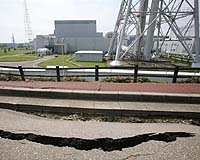
Experts led by the United Nations' nuclear watchdog will go to Japan next month for a third inspection of the world's largest nuclear power station since a July 2007 earthquake, it said Tuesday.
In a statement, the International Atomic Energy Agency (IAEA) said the 10 experts will "review the ongoing assessment of the impact of an earthquake on the Kashiwazaki-Kariwa nuclear power plant" during their December 1-5 mission.
The seven-unit power station has been shut since the July 16, 2007 earthquake that measured 6.8 on the Richter scale and automatically closed down its reactors. The temblor's epicentre was just 16 kilometres (10 miles) away.
The IAEA team "will study the ongoing evaluation by Japan's Nuclear and Industrial Safety Agency, and the owner of the plant, the Tokyo Electric Power Company, on the integrity of the plant structure and its components".
"The team will also review their re-appraisal of seismic safety at the plant based on newly defined seismic hazard assessments," the Vienna-based agency said.
Tokyo Electric Power has said that water containing only a small amount of radiation leaked into the Sea of Japan (East Sea) after the earthquake, and that radioactive particles blew out of an exhaust pipe filter.
But the utility came under criticism for initially under-reporting the severity of the incident.
Japan, one of the world's most earthquake-prone nations, relies on nuclear plant stations for nearly one-third of its power needs.
