
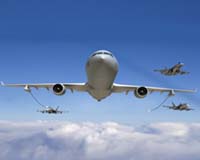
In the battle over a 35 billion dollar US Air Force tanker contract pitting favored Airbus over shunned Boeing, the outcome should be "Buy the Best Tanker," The New York Times said Friday.
Criticizing US lawmakers for calling the US Air Force to task for choosing a European manufacturer over an American one, the daily's editorial said the real consideration in assigning any manufacturing contract should be quality.
What would the lawmakers have the Air Force do, asked the daily, "buy a more expensive plane, and one that it says doesn't meet its needs nearly as well, if it were made by an American company?"
As to the much touted issue of job losses in the United States under the Airbus contract, the editorial warns against reprisals.
"Defense procurement is a global business. Boeing sells military aircraft and other defense systems all over the world. It and other American companies could suffer if a move to wrest the tanker contract from EADS and Northrop provoked a protectionist backlash in European capitals."
"For Congress to reverse the decision on 'Buy America' grounds would be bad for taxpayers: requiring them to pay for aircraft that provide less value for the money," said the Times.
"It would also be bad diplomacy and bad business. And that can't be good for the country."
The air force announced late Friday, to widespread surprise, that it had picked the team led by Northrop Grumman Corporation and the European Aeronautic Defense and Space Company (EADS) — the parent company of Airbus.
The Boeing Company had been heavily favored to win the contest to provide 179 new KC-45A tankers, an initial phase in replacing the air force's aging Boeing-made fleet.
With its defeat, Boeing's arch-rival in commercial aircraft, EADS subsidiary Airbus, based in France, will now assemble commercial 330s in Alabama. Separately, Northrop Grumman will convert the planes into tankers using sensitive military technology that is not to be shared.
Boeing suggested it may protest the air force decision, which has sparked a backlash in Congress over the spending of tax dollars on a military project that will partly profit a foreign company.
