
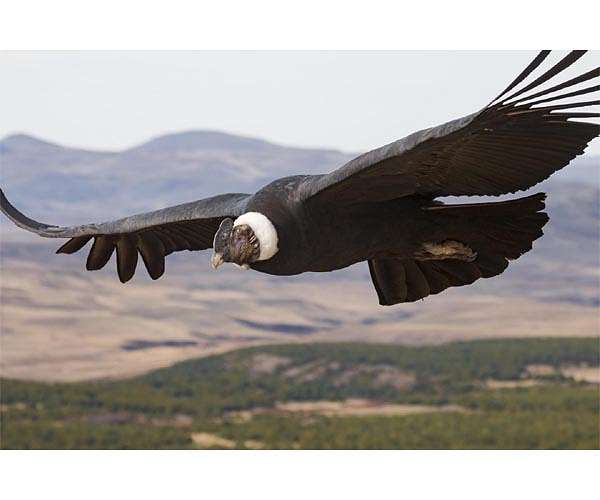
On a rocky outcrop in an Ecuadoran nature reserve, a pair of prolific Andean condors are giving conservationists a glimmer of hope that the species, under threat from poisoning and hunting, could yet survive and thrive.
The massive Andean condor (Vultur gryphus), which calls the South American mountain range home, has a 3.5-meter (11.5-foot) wingspan, making it one of the largest flying birds.
"This couple of condors is the most impressive and most prolific pair we know of for this species," says biologist Sebastian Kohn, director of the Andean Condors Foundation, which works closely with Ecuador's environment ministry.
Researchers have been observing the pair in the Chakana private nature reserve, set on the slopes of the Antisana Volcano, for the past seven years.
"Since 2013, when we first started studying them, they have already had seven chicks," said Kohn, whose team observes the birds with binoculars from a watchtower in the reserve, 50 kilometers (30 miles) southeast of Quito.
Normally, these long-lived monogamous birds reproduce slowly, a mating pair usually only producing a chick every two or three years.
Researchers say the likely reason for this pair's high reproduction rate is good access to food, especially carrion, and the feeling of security provided by being in the reserve.
But biologists are still concerned about the future of the species in Ecuador, and indeed throughout the mountain range.
Kohn says Ecuador — where 150 individuals were identified for a 2018 census — should raise its "critical alert level" for the species.
Globally, there are some 6,700 condors but numbers are declining. The International Union for the Conservation of Nature (IUCN) classifies the condor as "near threatened" on its watch list.
On another rocky outcrop in the reserve, at about 4,100 meters above sea level, is the main perch where about 40 of the birds have been spotted.
Kohn said that over the last two years, "we have lost 15 to 20 individuals, mainly due to poisoning" linked to the consumption of contaminated carrion meant for livestock predators, in addition to hunting.
In September, one of the birds, which researchers had named Iguinaro, was found dead. It had been released into the Chakana reserve only in May after being treated for gunshot wounds.
Once exposed to humans, animals start to lose their fear of predators
(UPI) Sep 22, 2019 –
New research suggests animals begin to lose their fear of predators once they start encountering humans on a regular basis.
For the study, scientists surveyed the findings of 173 peer-reviewed papers on predator avoidance behaviors and traits deployed by 102 species of domesticated, captive and urbanized mammals, birds, reptiles, fish and mollusks.
The analysis, published Tuesday in the journal PLOS Biology, showed predator avoidance traits and behaviors, including vigilance, freezing and fleeing, decreased as a result of exposure to humans.
Researchers found individual variation in anti-predator characteristics increased upon a species' initial exposure to humans, but then gradually decreased after generations of human exposure.
"While it is well known that the fact of being protected by humans decreases anti-predator capacities in animals, we did not know how fast this occurs and to what extent this is comparable between contexts," lead researcher Benjamin Geffroy, biologist at the University of Montpellier in France, said in a news release.
The findings suggest behavioral flexibility allows for the initial increase in the variability of anti-predator traits, but researchers suspect genetic changes solidify declines in predator avoidance as subsequent generations adjust to the presence of humans.
In the studies analyzed by Geffroy and his colleagues, domesticated animals lose their anti-predator traits much more quickly than urbanized animals, which can cause problems when domesticated or urbanized species are released back into the wild.
"We also integrated physiological traits in the study but they were much less numerous that behavioral traits," Geffroy said. "We believe they should be systematically investigated to draw a global pattern of what is happening at the individual level.
"We need more data to understand whether this occurs also with the mere presence of tourists," Geffroy said.
