
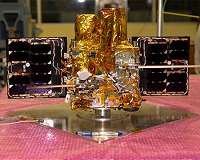
The Indian Nano Satellite-1C (INS-1C) is an experimental satellite launched by PSLV-C40 on Jan 12, 2018 as a co-passenger payload. It is the third satellite in the Indian Nano Satellite (INS) series.
The first two satellites (INS-1A and INS-1B) of this series were carried as co-passenger payloads by PSLV-C37 in February 2017. INS-1C carries Miniature Multi-spectral Technology Demonstration (MMX-TD) Payload from Space Applications Centre (SAC), ISRO Ahmedabad.
Compact imaging systems with reduced weight and size offer tremendous opportunities for their use in space borne micro/nano satellites and planetary missions where size and weight are at a premium.
Although miniature cameras such as those found in cell-phones are now available commonly, their resolution and light collection are poor with respect to their full size counterparts.
Robust Technology Development Programme of SAC/ISRO developed an innovative satellite payload using the concept of Origami – the art of folding paper.
ISRO Nano Satellite (INS-1C) payload team has used the concept of multi-fold reflective optics to design imagers of significantly reduced thickness compared with conventional refractive cameras.
This multi-fold optical configuration is known as Origami optics. It is important to note that the reflective optics is based on metal mirrors, rather than the usual glass based Origami lens.
The use of metal reflectors makes the camera potentially much more versatile in terms of spectral coverage. The mirrors and the optical assembly were developed indigenously. The optics is fabricated using single-point diamond turning machine with a fast-tool servo.
