
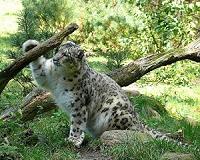
A rare snow leopard captured as it savaged livestock in a remote village in the Indian Himalaya will be sent to a zoo instead of being released, officials said Sunday, triggering outrage from activists.
The endangered creature was found on Saturday after it became trapped inside a pen containing sheep and goats in Giu village near the Tibetan border in India's Himachal Pradesh state.
"The big cat was unable to escape from the enclosure after killing a few livestock," wildlife official Hardev Negi, who led the team that caught the snow leopard, told AFP.
"The shepherd contacted us and we captured the animal in a cage."
The state's chief wildlife official Savita Sharma told AFP the snow leopard was not being released since the incident involved "wild animal-human conflict," adding it would be transferred to a zoo in the foothills outside the state capital Shimla.
Officials estimated that the juvenile animal killed 43 sheep and goats in the pen over four days.
There are only 44 snow leopards living in the high passes and rugged valleys of Himachal Pradesh, according to Sharma.
Rajeshwar Negi, the National Convener of Nature Watch India said the decision was condemning the creature to a life without freedom.
"Don't they know how stressful it will be for the animal to be transported on a bumpy 350-kilometre long road," he told AFP.
"Does it mean the snow leopard will spend the rest of its life in a zoo instead of the Himalayan wilds?"
He added that the animal would also suffer in the higher temperatures at the zoo in Shimla, which is significantly warmer than its natural habitat.
As few as 4,000 of the mysterious animals could be left in the high mountains of central Asia — their sole habitat — according to the World Wildlife Fund.
Negi said snow leopards were being forced to move to lower altitudes and prey on domestic animals as the populations of their natural prey — the ibex and blue sheep — have been decimated by hunting.
Global warming is also threatening the survival of the big cat, with warmer temperatures pushing the tree line higher and prompting farmers to move further up the mountains to plant crops and graze livestock, encroaching on the snow leopards' territory.
First giant panda born in Netherlands
The Hague (AFP) May 2, 2020 –
Wu Wen, a giant panda loaned to a Dutch zoo by China, has given birth in a first for the Netherlands, Ouwehands animal park announced Saturday.
Mating took place in January and the cub, which belongs to Beijing just like the mother and father Xing Ya, was born on May 1.
"The mother and her cub are staying in the maternity den and are doing well," the zoo in the central city of Rhenen said in a statement said.
"This cub was born and conceived naturally," said Ouwehands owner Marcel Boekhoorn.
"Male or female? The cub's gender will remain a surprise for the time being," he added.
"The keepers are leaving Wu Wen and her cub alone. When the cub leaves the maternity den after a few months, we will be able to see what the gender is.
"When that happens, the little giant panda will be named," Boekhoorn said. The cub will go to China after four years to join the breeding programme.
The mother and father were loaned to the Netherlands in 2017 for 15 years.
Giant pandas are found only in the wild in China where their habitat is shrinking.
However since 2016 they are no longer considered in danger of extinction but remain "vulnerable".
