
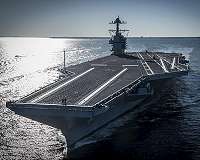
The US Department of Defense has added $3.4 billion to the costs of its 30-year-long program to build six new super nuclear-powered Ford-class aircraft carriers, the Congressional Budget Office (CBO) noted in a report.
In 2006, the Congress placed a limitation [cost cap] of $8.1 billion on the amount the Navy could spend on the second and following ships in the Ford class," the report said on Wednesday. "As a result of such adjustments, the Navy – in 2013 – raised the cost cap to $11.5 billion."
The Department of Defense submitted to the Congress the Navy's 2016 shipbuilding plan in April 2015 to purchase six Gerald R. Ford class aircraft carriers over the 2016-2045 period, the report noted.
"Actual inflation in the prices of labor and materials was the most important contributor to the rise in the cost cap, accounting for $2.5 billion of the $3.4 billion increase, according to analyses by both the Navy and CBO" the report continued.
From 2007 to 2013, economic inflation specific to the US aircraft carrier program totaled 31 percent, an average annual rate of 3.96 percent, the CBO documented.
US Navy Spending Soars with $81 Billion Shipbuilding Spree
Is the US gearing up for WWIII, or are the lobbyists signing the checks for US military spending?
The US Navy announced plans on Wednesday to build 38 ships in the next five years, including nine Virginia-class submarines and 10 Arleigh-Burke-class guided missile destroyers. The plans were detailed during testimony before the Senate Armed Services Committee.
The program will bring the US Navy fleet to a total of 308 ships by FY 2021 – up from the current 272 – and will lead to a 10% increase in the number of US amphibious assault ships, a development that received praise from Naval combatant commanders and also the Marines tasked with deploying them.
The centerpiece expenditure is a new class of nuclear-powered aircraft carrier, the Gerald R. Ford, in which the Navy plans to invest some $13.5 billion over the next five years. The hefty price tag makes the warship the single most expensive boat in the US Naval fleet.
The spending may be driven less by America's military strategic imperative and more by corporate interest and congressional aspiration. Huntington Ingalls Industries Inc., General Dynamics Corp, Lockheed Martin Corp., Austal Ltd. and Raytheon Co. have all released statements to investors celebrating the planned expenditures as signaling the growing value of their companies to shareholders.
The plan has also received praise from the congressional delegation of top shipbuilding states, including Virginia, Maine, Alabama, Mississippi and Connecticut, states that benefit significantly from US military contracts, maintaining high-paying jobs within their districts. To that effect, shipbuilding and steelworker unions have also praised the new ship building plan as critical to maintaining its workforce.
