
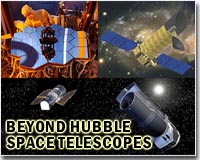
Many international space agencies are deploying advanced technologies to capture images that help us to better understand the universe. Mapping attributes of planets and systems, such as Mars' gravity distribution or the cosmic radiation generated by the center of the Milky Way contribute to our collective knowledge of how the galaxy works. Here are a few examples of how inspirational imagery leads us to discover important new knowledge.
Recent discoveries include the bouncing back to the Milky Way of the Smith Cloud Smith Cloud – a huge mass of hydrogen gas that's on a collision course with our galaxy and hurtling along at about 700,000 miles per hour. The Hubble Space Telescope was used to observe what was once considered an unsuccessful galaxy lacking stars. The telescope's Cosmic Origins Spectrograph was also deployed to measure how ultraviolet (UV) light from very distant active galaxies is able to filter through the cloud. Astronomy student Gail Smith discovered the cloud in the 1960s. On its current trajectory, it's expected to get back to the galactic disk in about 30 million years.
Gravity on Mars
Three NASA spacecraft have made a detailed map of the interior of the Red Planet. The process has been described as a bit like a physician taking an X-ray, because it gets beneath the skin of the planet to reveal what's happening inside. Deep Space Network gathered the data and a 16-year record of changes collected by orbiting craft enabled the team to assemble a map of the gravity field on Mars. As a result, indications that the planet has a liquid outer core made up of molten rock were confirmed and geophysicists were able to go to work on improving models of the interior, thanks to better measurements of tides.
The galactic ribbon
The Chandra X-ray Observatory at NASA helped astronomers to increase their knowledge of how systems interacted by enabling them to carefully examine the properties of the Zwicky 8338 galaxy cluster, which is sporting an enormous 'tail' or ribbon composed of X-ray emissions. This is likely to be the largest hot gas tail of its kind that has ever been detected, estimated to be about 250,000 light-years long. Scientists are keen to know how it is affecting its immediate environment.
Small beginnings
Undoubtedly, the Hubble Telescope in particular has captured some amazing images, especially using gravitational lensing, to produce revealing pictures of smaller, fainter galaxies that are furthest away. Astronomers around the world have examined a variety of these images and concluded that the first generation of galaxies provides the backstory to the universe as it is today. Some of these images took about 12 billion years to reach the Hubble Telescope and scientists also learned that accumulated UV light might well have led to re-ionization. It seems that these smaller but plentiful galaxies are likely to be major players in terms of keeping the universe transparent.
Enhanced images of space
When you think about how long it takes some images to be picked up by telescopes, like Chandra X-ray Observatory or NASA spacecraft using Doppler, you won't be surprised to learn that the pictures we are used to seeing have to be expertly enhanced in order for us to interpret them correctly. Long exposure times are necessary to capture true colors – something telescopes cannot achieve, as they are typically greyscale. Instead, expert interventions convert original pictures of planets, galaxies, suns and stars to 3D images that have structure, depth and color that reflect temperature variations and chemical compositions.
The intelligent processing of original images is vital to provide true representations of space phenomena. Telescope images do contain some color information, despite appearing greyscale. To interpret this, a filter is used – either broad-band (often used for galaxies) or narrow-band. It's accurate to say that the pictures captured by Mars Exploration Rovers (MER) is probably closer to "true" rather than "false" color, unlike Hubble which is deemed mostly "false" by some commentators. Having said that, experts claim that on Mars as well as on Earth that color changes all the time depending on the atmosphere and sunlight. Maybe it's safer then to talk of "representative" colors rather than true ones.
Educational value
If we flip back to the importance of contributing to our collective knowledge about how space works, it becomes clear that these enhanced images make a real and important difference to our understanding of the universe. Everyone deserves to have access to the visual information contained in extraterrestrial photographs. For example, educational projects benefit students in school and can be used to inspire future astronauts and space engineers. The awesome stock video footage of space events that's available to all needs to be put to good use.
Future imagery
As technology continues its relentless advances, how will images of space, galaxies, planets and everything extraterrestrial be gathered in the future? There are advocates of smartphone capacity and even some who have published images of the Milky Way taken using smartphones and appropriate lenses, sensors and software. Once upon a time, we may have dismissed the imaging capabilities of smartphones as secondary to those of "proper cameras," however; today's technology is beginning to put previous generations of cameras to shame. The OnePlus One, for instance, has more sophisticated sensors than you'll find in your mirror-less camera or DSLR. When you make it easier for everyone to capture great images, this has to be a good thing.
Moving forward
As the expression goes, a picture says a thousand words. You can write reams of text explaining galactic phenomena – and this is valuable in terms of developing explanations and understanding of what can be seen – but it doesn't come anywhere near to the incredible images that are fed back from international space agencies. As the technology of image production moves forward, you can gain clearer insights into the marvels of the universe and get a closer understanding of the infinite wonders and mysteries of space.
