
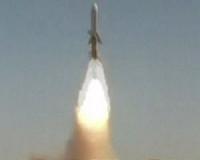
Iran on Sunday unveiled two new missiles and two new drones it said have been added to its arsenal, in a ceremony attended by President Hassan Rouhani.
The Ghadir (Mighty), with a range of 300 kilometres (185 miles), is a ground-to-sea and sea-to-sea missile, the official IRNA news agency said.
It is in the same family as the Ghader or Qader cruise missile, which has a range of 200 kilometres.
The other missile unveiled on Sunday, the Nasr-e Basir (Clear Victory), is equipped with a seeker homing head. Its range was not given.
The new Karar-4 (Striker) drone can track and monitor enemy aircraft, the agency said, while the Mohajer-4 (Migrant) drone is designed to perform photographic and mapping missions.
Iran has developed a major missile programme in addition to producing different types of Unmanned Aerial Vehicles (UAVs), including attack drones.
The United States, whose Fifth Fleet is based in Sunni-ruled Bahrain across the Gulf from the mainly Shiite Islamic republic, has repeatedly expressed concern about these two programmes.
Rouhani on Sunday sought to allay such fears.
"Iran has no intention to interfere in, dominate or attack other countries or plunder their resources," he said in a speech broadcast on state television, adding that the country's military doctrine was defensive.
"But at the same time we will stand up to any aggression," he added.
In May, Iran said it had succeeded in copying an American RQ-170 Sentinel drone that it forced down and recovered nearly intact in December 2011.
Tehran is currently engaged in negotiations with the five permanent members of the UN Security Council plus Germany — known as P5+1 — on securing an agreement with world powers on its controversial nuclear programme.
Israel and Western powers suspect Iran's civilian nuclear project to be a cover to develop an atomic weapon, an allegation Tehran denies, insisting its uranium enrichment drive is entirely peaceful.
Iran FM to meet EU's Ashton for nuclear talks Sept 1
Tehran (AFP) Aug 24, 2014 –
Foreign Minister Mohammad Javad Zarif will meet EU foreign policy chief Catherine Ashton on September 1 in Brussels to agree a framework for renewed nuclear talks, Iran said on Sunday.
Ashton is the lead negotiator for the six major powers seeking to reach a comprehensive agreement with Iran to allay long-standing international concerns about its nuclear programme by November 24.
The two sides had been working to a July target date but then they agreed to extend it to give more time to reach a historic deal.
The new round of full talks will take place in New York ahead of the opening of the UN General Assembly on September 16, Deputy Foreign Minister Abbas Araqchi told the official IRNA news agency.
He said Iran would hold preparatory bilateral meetings with some of the six powers — Britain, China, France, Russia and the United States plus Germany — ahead of the talks.
The negotiations are the fruit of an interim deal that the powers reached with Iran last November, under which Tehran reined in some of its nuclear activities in return for limited relief from Western sanctions.
Diplomats say the talks have been making headway but that big differences remain over key elements of an eventual deal.
Iran wants a swift lifting of crippling Western sanctions, while the powers are pushing for much tighter curbs on uranium enrichment than Iran has been willing to accept.
The sensitive enrichment process — which can produce fuel for nuclear power stations or, in highly extended form, the core of an atomic bomb — has long been at the centre of international concerns about Iran's ambitions.
