
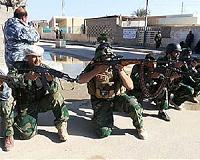
Iraqi forces fought Friday to retake part of a northern town and nearby areas seized by gunmen, killing over a dozen militants and at least temporarily regaining territory, officials said.
The Thursday takeover of part of Sulaiman Bek and nearby villages in Salaheddin province came as gunmen hold a major city and part of another in the western province of Anbar, in a stand-off that has lasted weeks.
Local official Talib al-Bayati told AFP that security forces backed by tanks and other armour began attacking militant-held areas on Friday morning.
Engineers moved in first to search for bombs, he said, adding that security forces had killed 17 militants in the area since Thursday.
Bayati later said that security forces had succeeded in retaking the militant-held areas, but then withdrew for unknown reasons.
It was not immediately clear whether the situation was resolved, or if the withdrawal would allow militants to move back in.
Army Staff Lieutenant General Abdulamir al-Zaidi meanwhile said that security forces were able to regain control of the Sulaiman Bek area after heavy fighting.
Last July, some 150 militants carried out a coordinated operation in the Sulaiman Bek area, attacking with mortar rounds, automatic weapons and rocket-propelled grenades.
The violence drew security forces away from a nearby highway, where several dozen militants set up a checkpoint and executed 14 Shiite Muslim truck drivers.
Sulaiman Bek was also briefly seized by militants in late April last year.
Iraqi authorities face a far more serious problem in Anbar province, where gunmen have held all of the city of Fallujah and parts of provincial capital Ramadi for weeks.
Violence in the country has reached a level not seen since 2008, when Iraq was just emerging from a period of brutal sectarian killings.
Gunmen killed four police near the city of Tikrit on Friday, while security forces killed six militants in the northern province of Kirkuk, officials said.
Foreign leaders have urged the Shiite-led government to do more to reach out to the disaffected Sunni Arab minority to undercut support for militants.
But Prime Minister Nuri al-Maliki has taken a hard line ahead of a general election scheduled for April.
Iraq PM announces training, funds in battlefield city
Baghdad (AFP) Feb 15, 2014 –
Iraqi Prime Minister Nuri al-Maliki promised training for allied tribal militia and over $83 million in construction funds during a visit Saturday to Ramadi, where militants hold territory seized weeks ago.
The measures are the latest in a bid to placate people in Anbar province, whose capital is Ramadi, and Iraq's broader Sunni Arab minority, which complains of marginalisation by the government and of being unfairly targeted by heavy-handed security measures.
Maliki's visit came as militants killed more than two dozen soldiers and police in other parts of the country over two days and held part of the northern town of Sulaiman Bek, another front in the persistent rebellion against his Shiite-led government in Sunni areas.
It was the first time Maliki is known to have travelled to Anbar since jihadists and anti-government tribesmen seized parts of Ramadi and all of nearby Fallujah at the start of the year, in a major setback for his government.
The premier's spokesman, Ali Mussawi, told AFP he met with provincial officials and leaders of powerful local tribes.
"We came to confirm our support to our people and our tribes in Anbar," Mussawi quoted Maliki as saying.
He also announced 100 billion dinars (about $83.3 million/60.8 million euros) in construction funds for the province, and that security forces would provide training to pro-government tribesmen, Mussawi said.
But with corruption a major and persistent problem in Iraq, it is unclear how much of the construction money will provide tangible benefits to Anbar residents.
Earlier this week, Maliki said tribesmen who fight on the side of the government would be incorporated into the Anbar police, but it was not immediately clear how the new promise fits into that plan.
The takeovers in Anbar are the first time anti-government forces have exercised such open control in major cities since the bloody insurgency that followed the US-led invasion of 2003.
More than 370,000 people may have been displaced by Anbar violence, according to the UN.
The prospects of a quick resolution to the crisis seem slim, with Deputy Prime Minister Hussein al-Shahristani saying the strategy for retaking Fallujah is to surround it and wait for Sunni Arab gunmen to run short of weapons and equipment.
– Part of northern town held –
Authorities also face a small-scale version of the Anbar crisis in northern Iraq, where militants took control of part of the town of Sulaiman Bek and nearby areas in Salaheddin province on Thursday.
Local official Talib al-Bayati told AFP security forces had succeeded in retaking militant-held areas on Friday, but then withdrew for unknown reasons.
On Saturday, gunmen were in control of the town's Al-Askari neighbourhood, he said.
Sulaiman Bek has been hit by numerous attacks over the past year, and was briefly seized by militants in late April.
In July, 150 militants struck with mortar rounds, rocket-propelled grenades and automatic weapons, and executed 14 Shiite truck drivers on a nearby highway.
Meanwhile, 26 soldiers and police have been killed in targeted attacks and clashes over the past two days, mainly in Salaheddin, officials and doctors said.
The often poorly trained and disciplined security forces are the target of near-daily attacks by militants.
Violence in Iraq has reached a level not seen since 2008, when the country was just emerging from a period of brutal sectarian killings.
Foreign leaders have urged the Shiite-led government to do more to reach out to the disaffected Sunni Arab minority to undercut support for militants.
But Maliki has taken a hard line ahead of a general election scheduled for April.
