
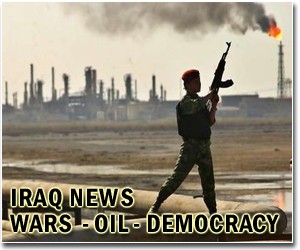
The number of people killed in violence in Iraq in November was the lowest in a year for the second month running, government figures showed Wednesday.
The figures, compiled by the defence, interior and health ministries, showed that 171 people — 105 civilians, 23 soldiers and 43 policemen — died in attacks in November.
That represents the lowest number since November 2009, with monthly death tolls having now having fallen for five consecutive months. The October death toll of 185 was also lower than the figure in November 2009.
In all, 293 people were wounded in November's violence, including 155 civilians, 60 soldiers and 78 policemen.
The figures also showed that 40 insurgents were killed and 195 arrested.
earlier related report
Mubarak told US to allow dictator in Iraq: WikiLeaks
Cairo (AFP) Nov 30, 2010 –
Egyptian President Hosni Mubarak advised the United States in 2008 to "forget" about democracy in Iraq and allow a dictator to take over, according to a diplomatic cable released this week on WikiLeaks.
Mubarak made the comments during talks with visiting US congressmen to whom he also admitted that he was "terrified" by the possibility of a nuclear Iran, in the cable sent home from the US embassy.
He noted to the US delegation he had advised Washington against the 2003 invasion of Iraq to depose dictator Saddam Hussein.
But now that they had troops in mainly Shiite Iraq, American troops should not withdraw because that would only serve to strengthen Shiite Iran next door.
"You cannot leave" because "you would leave Iran in control," the diplomatic dispatch, dated May 27, 2008 according to the website, quoted him as saying.
"Mubarak explained his recipe for going forward," the cable said.
"Strengthen the (Iraqi) armed forces, relax your hold, and then you will have a coup. Then we will have a dictator, but a fair one. Forget democracy, the Iraqis by their nature are too tough," Mubarak said in the cable.
He said he would never accept a nuclear Iran and acknowledged: "We are all terrified."
Mubarak said he told former Iranian president Mohammad Khatami to tell his hardline successor Mahmoud Ahmadinejad not to "provoke" Washington into striking Iran.
Egypt would begin its own nuclear programme if Iran's succeeded, he was quoted as saying.
The congressmen also met Egypt's intelligence chief Omar Suleiman, who "advocated making Iran suffer economically to be 'too busy with its people' to make problems in Iraq."
The memo was marked confidential and addressed to the US secretary of state at the time, Condoleezza Rice.
Share This Article With Planet Earth
