
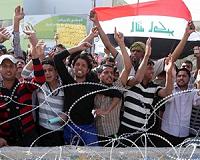
Thousands took to the streets in Iraq's capital and across the south Sunday to protest against Iran's kingmaking influence, as the latest deadline for choosing a new prime minister loomed.
Anti-government rallies have rocked Baghdad and the Shiite-majority south since October 1, with demonstrators calling for a complete overhaul of a regime they deem corrupt, inefficient and overly beholden to Tehran.
"The revolution continues!" shouted one demonstrator at a protest encampment in central Diwaniyah.
Protesters blocked off public buildings one by one in the southern Iraqi city and put up banners reading, "The country is under construction — please excuse the disruption".
As the clock ticked closer toward Sunday's midnight deadline for choosing a new premier, the demonstrators stepped up their protests, blocking highways and roads across the south of Iraq with burning tyres.
The deadline for parliament to choose a new prime minister to replace Adel Abdel Mahdi, who quit last month, has already been pushed back twice by President Barham Saleh.
Officials say Iran wants to install Qusay al-Suhail, who served as higher education minister in the government of Abdel Mahdi.
"This is exactly what we oppose — Iranian control over our country," said 24-year-old student Houeida, speaking to AFP in Baghdad's Tahrir Square, the epicentre of the protests.
The demonstrators categorically reject Suhail's candidacy, along with anyone from the wider political establishment that has been in place since dictator Saddam Hussein was deposed in 2003.
"Hundreds of martyrs have fallen and they are still not listening to our claims", said 21-year-old student Mouataz, in Tahrir Square.
"We want a prime minister with integrity, but they bring back a corrupt man in their image whom they will allow to continue robbing us," he added.
Parliament speaker Mohammed al-Halbussi on Sunday travelled to Arbil, capital of the Kurdish autonomous region in northern Iraq, to discuss who could become the next premier, the presidency there said.
– 'Iraq must be Iraqi again' –
In a bid to secure the necessary parliamentary majority for a new premier, Shiite powerhouse Iran enlisted the services of a Lebanese Hezbollah official to negotiate with Sunni and Kurdish parties.
The post of prime minister is by convention held by a Shiite in Iraq's post-2003 political system.
In a Twitter plea to Saleh, one opposition Sunni lawmaker called Sunday for the president to "violate the constitution rather than plunge the country into bloody chaos by choosing a figure people have already rejected".
Some in parliament — the most fragmented in Iraq's history — argue that Saleh should use Article 81 of the Constitution, which authorises the president to step in as prime minister himself if there is no agreement among lawmakers on a candidate.
Saleh sought guidance from the Supreme Court on what constitutes a parliamentary majority to choose a premier, but on Sunday the tribunal sent him a letter saying "all options are open", further adding to the confusion.
If the post remains vacant at midnight, the constitution will place Saleh himself in the role of acting premier for just 15 days until political leaders can agree on designating a new premier.
In a sign of the protesters' unprecedented influence, top Shiite cleric Grand Ayatollah Ali Sistani, who is said to have made and unmade every premier in the post-Saddam era, has been notably absent from the manoeuvrings this time around.
The protest movement has been hit by intimidation, including assassinations perpetrated by militias, according to the UN.
Around 460 people have been killed since October 1, and some 25,000 have been wounded.
Yet the protesters appeared unbowed on Sunday.
Overnight, demonstrators in Diwaniyah and Basra, another southern city, had declared a "general strike".
They burnt tyres to block roads linking southern cities to Baghdad, an AFP correspondent said.
The road to Umm Qasr port — vital for imports — near Basra was among those blocked.
In Karbala and Najaf, two Shiite holy cities, striking students closed schools and gathered in their thousands, AFP correspondents said.
In Nasiriyah, protesters blocked bridges and several roads while all public buildings remained closed.
Protesters are demanding the fall of Saleh and Halbussi, accusing them of procrastinating.
"Iraq must become Iraqi again, and if the president does not help us, we will force him out too," asserted student Houeida, buoyed by the renewed momentum in Tahrir Square.
Baghdad's 'Tahrir Beach' where the revolution takes a break
Baghdad (AFP) Dec 22, 2019 –
Close to Baghdad's protest hotspot of Tahrir Square, a sandy Tigris River bank offers some relief from the revolution: youths kick around footballs and smoke shisha pipes to booming hiphop music.
It is on this half-kilometre (500-yard) stretch where the post-Saddam generation celebrates its uprising on the beach, escaping the teargas and bullets for a fun and festive atmosphere.
"Our leaders have deprived us of everything — our rights, our money, our dignity," says Ammar Saleh, 20. "Here we simply discover the taste of freedom."
Unemployed and penniless, another man here, Ali, is intoxicated by the wind of revolt that has swept through Iraq since early October in the biggest wave of street rallies since the 2003 US-led invasion.
"We have nothing left to lose, we will not move as long as the thieves in power don't leave office!" he says with fervour, then returns to his football game.
"Tahrir Beach", as its occupants call it, has maintained the carnival-like atmosphere of the protests before they were marred by bloodshed and fear.
"This is where you find the magic of the early days of the movement," says journalist Ali, a regular visitor.
In the almost three months since the rallies started, about 460 people have been killed and 25,000 wounded. The initially self-managed camps at Tahrir Square have become more strictly organised and the carefree spirit has gone.
"There is less mobilisation, leaders have changed, militiamen and spies have infiltrated the demonstrators," said Ali, who pointed also to the growing influence of supporters of Shiite populist leader Moqtada Sadr.
– 'We want joy' –
Tahrir Beach lies on the east bank of the Tigris, between the Al-Sinek and al-Jumhuryiah bridges, where security forces guard access routes into the locked-down "Green Zone" government and embassies district.
Along Rashid Street, centuries-old brick houses with elaborate wooden balconies, now mostly dilapidated, tell the story of the capital city's past glory.
Bland modern buildings now mar the cityscape as do the concrete blast walls, covered with protest graffiti.
Red and yellow tuk-tuks – the three-wheeled taxis that have become a revolutionary emblem – pour their smiling passengers onto the stretch of river-front, to be greeted by rows of shisha water pipes.
Everywhere there are reminders of the "martyrs" who fell on the barricades: improvised mausoleums adorned with now wilted flowers, a construction helmet, a bloodied t-shirt.
Black, red and white Iraqi flags flutter in the breeze, alongside the inevitable FC Barcelona logo.
"Dumping garbage is forbidden," reads a sign suggesting the civic-minded spirit of the "new Iraq", even if litter on the ground suggests not everyone is on board yet.
Under Saddam Hussein and the civil war that followed it was unthinkable to wander around here, so close to the dictator's palaces and then the headquarters of the US occupation.
"It was too dangerous! There were no people, just dogs at night," recalls Ayman, a former resident of the area.
Now a new generation is reappropriating the river bank, as expressed in a slogan daubed on a wall: "We have cried so much, now we want joy."
– Downward-facing dog –
Indeed, even though it's a short walk to Tahrir Square, the violence seems far away.
Three teenagers try to free a scooter stuck in the beach, the rear wheel spraying up sand. Youths with pulled-up pants play volleyball.
A temperamental sound system spits out Iraqi techno and the rap hit "I Got Love", while a piece of linoleum serves as the stage for a hip-hop dance contest.
Bandanas wrapped around their heads, two guys pumped up with testosterone twirl and spin to the crowd's applause.
The day before, a yoga class here produced photos of bulked-up and beared men performing the one-legged downward-facing dog pose, sparking delight on social media.
The crowd remains predominantly young and male — and poor.
One young man, 26-year-old Sofiane, his arm deformed by polio, says he has "never received the slightest allowance" but expresses hope the demonstrations will "change everything".
A group of girls stroll past, their long black hair blowing in the wind. They receive discreet glances but no one bothers them.
The young ladies sip soft-drinks while squinting at guys with slicked-up hairstyles who are shaking their hips to the rhythm of a song that decries the "rotten politicians".
As teenagers splash in the brackish river water and toddlers build sand castles, some incredulously film the relaxed scene with their smartphones.
"These scenes were unimaginable just a few months ago," Ali marvels. His voice darkening slightly, he adds that he is "not sure it will last".
