
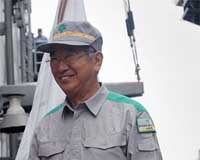
A minor Japanese opposition party, led by former nationalist Tokyo governor Shintaro Ishihara, split into two Wednesday as his drive to change the country's pacifist constitution backfired.
Ishihara met flamboyant Osaka city mayor Toru Hashimoto, who had shared the chair of the conservative Japan Restoration Party, and they agreed to part company.
An attempt by Hashimoto to merge with another minor force in parliament, the Unity Party, contributed to the breakup.
Unity rejects Ishihara's drive to scrap the US-inspired post-World War II constitution.
"I cannot side with a political party which does not accept the establishment of an independent constitution," the 81-year-old Ishihara told reporters.
"I asked (Hashimoto) to divide the party into two. Mr Hashimoto accepted this."
Ishihara has long advocated the creation of a new constitution which allows Japan to have strong armed forces which can go to war. The present charter bans the use of force in settling international disputes.
Ishihara's own political group joined Hashimoto's in late 2012, when he renounced the Tokyo governorship to return to national politics through general elections in which the conservative Liberal Democratic Party (LDP) regained power with a landslide victory.
But the two strong characters have differed on important issues including nuclear power.
Ishihara has pushed for the restarting of nuclear reactors which were switched off after the 2011 earthquake and tsunami sparked meltdowns at the Fukushima nuclear power plant.
The Japan Restoration Party has 53 seats in the 480-seat lower house of parliament and nine in the 242-seat upper chamber.
The Unity Party has nine seats in the lower house and five in the upper house.
Unity Party leader Kenji Eda said Ishihara's views on the constitution will hinder a "further reorganisation of opposition parties".
The LDP, led by Prime Minister Shinzo Abe, has a solid majority of 295 seats in the lower house and a near-majority 115 seats in the upper house, where it is aligned with the centrist Buddhist-backed New Komeito Party.
