
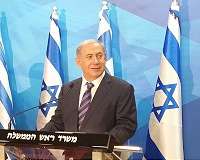
Prime Minister Benjamin Netanyahu said Monday Israel would not allow "Iranian aggression", after its military struck what it called Iranian targets in Syria in response to missile fire.
"Yesterday evening, the air force struck a strong blow against Iranian targets in Syria after Iran fired a missile from there toward Israel," Netanyahu said at an inauguration ceremony for a new airport in southern Israel.
"We do not allow such acts of aggression to pass by. We are acting against Iran and against the Syrian forces who are tools of Iranian aggression."
Israel struck what it said were facilities belonging to the Iranian Revolutionary Guards' Quds Force early Monday in response to a missile attack it blamed on Iran.
The surface-to-surface missile, fired towards the Israeli-occupied Golan Heights on Sunday and intercepted by air defences, followed an alleged Israeli strike in southern Syria.
The chain of events sparked concerns of an escalation, after a monitor reported 11 fighters killed in the overnight Israeli strikes.
Israel has carried out hundreds of air strikes in Syria against what it says are Iranian military targets and advanced arms deliveries to Tehran-backed Hezbollah.
It rarely publicly confirms them, though has in recent days spoken about the raids more openly.
Israel has pledged to keep arch-foe Iran from entrenching itself militarily in neighbouring Syria.
Israeli attacks in Syria: What you need to know
Jerusalem (AFP) Jan 21, 2019 –
Israel attacked what it said were Iranian targets in Syria early Monday in response to missile fire it blamed on Iran.
Here are a series of questions and answers on the situation:
– What happened? –
Israel announced a series of air strikes against facilities it said belonged to the Iranian Revolutionary Guards' Quds Force in the early hours of Monday.
It said the strikes were in response to a medium-range, surface-to-surface missile the Quds Force fired from Syria at the Israeli-occupied Golan Heights on Sunday, which Israeli air defences intercepted.
Earlier that day, Damascus had accused Israel of carrying out raids in southern Syria.
The Syrian Observatory for Human Rights war monitor said at least 11 pro-regime fighters, including two Syrians, were killed in Monday's strikes.
– Why does Israel attack in Syria? –
The Israeli army has since 2013 claimed hundreds of attacks on what it says are Iranian military targets and advanced arms deliveries to Tehran-backed Hezbollah, with the goal of stopping its main enemy Iran from entrenching itself militarily in neighbouring Syria.
On Monday, Israeli Prime Minister Benjamin Netanyahu said that Iran made "explicit statements" on its intention "to destroy Israel".
– Which Iranian forces are in Syria? –
Thousands of pro-Iranian forces have been deployed to Syria over the course of the war, according to Observatory.
They include members of the Islamic Revolutionary Guard Corps headed by Qassem Soleimani, the mastermind of Tehran's military strategy in the region.
Iran also deployed temporarily at some point during the conflict one commando unit of the regular army alongside tens of thousands of militiamen belonging to Shiite groups, including Lebanon's powerful Hezbollah.
According to the head of the IRGC, Iran has "military and revolutionary advisors" in Syria.
Major General Mohammad Ali Jafari has also said that there is "equipment and weapons necessary for training and empowering the Islamic resistance fighters and for supporting the oppressed people of Syria".
Jafari made those comments on January 16 when responding to Netanyahu's demand that Iran remove its forces from Syria, saying that those elements would "be kept there".
– What about the US withdrawal from Syria? –
Some observers argue that a US troop pullout will create a vacuum allowing Iran to further expand its influence in Syria, including by consolidating a "land bridge" to the Mediterranean and bringing Tehran's military capabilities closer to Israel's northern borders.
Israeli officials and analysts have stressed that the Jewish state has long managed that front alone and would continue to do so.
Russia is the other main backer of the government in Damascus but is sometimes described as Iran's main rival in Syria and has done little to stop Israeli strikes against Iranian interests there.
– Do Israel and Russia coordinate in Syria? –
The two countries have long had a hotline to avoid accidental clashes in Syria, but Israel has had to tread more carefully in recent months.
A friendly fire incident in September that led to a Russian plane being downed by Syrian air defences during an Israeli raid angered the Kremlin.
As part of its response, Russia delivered the advanced S-300 air defence system to Syria.
