
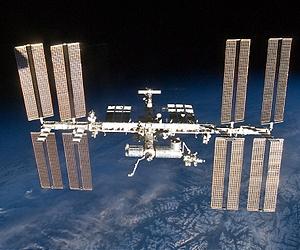
The service life of the International Space Station (ISS) may be extended until 2028, a Russian space official said on Tuesday. The service life of the ISS ends in 2015 but participants of the project – Canada, the European Union, Japan, Russia and the United States – have recently agreed to extend its operation until at least 2020.
"At present, experts have been instructed to find ways to extend the station's service life until 2028," Alexei Krasnov, the head of Roscosmos manned spaceflight programs, told the participants of the Space Forum 2011.
The orbital station could be used as an assembly line and a launch pad for experimental spacecraft, including small satellites, he said.
"These are going to be small-size satellites, but we will be able to launch them from the ISS to a variety of orbits," Krasnov said.
NASA earlier called the ISS "an anchor for the future of human space exploration" and a major component of the U.S. human space program.
ISS service life to be extended to 2028
Moscow (XNA) Oct 20 – The service life of the International Space Station (ISS) could be extended by eight years to 2028, Russian space agency Roscosmos said on Tuesday.
Experts from several countries have been instructed to find ways to extend the service life of the ISS, a Roscosmos official said.
The space station might be used as an assembly plant and a launch pad for experimental spacecraft in the future, Alexei Krasnov told the Space Forum 2011 in Korolyov near Moscow.
Marc Polansky, a representative from U.S. space agency NASA, also told the forum that the ISS would be a training ground for deep space manned expeditions.
"It is time to get away from the low orbits to the deeper space," Polansky said.
According to the Interfax news agency, the European Space Agency is ready to support the extension of the ISS service life till at least 2020.
The ISS was originally set to cease its service in 2015. Participants of the ISS project, including the United States, Canada, Russia, Japan and the European Union, have agreed to extend its operation to 2020.
