
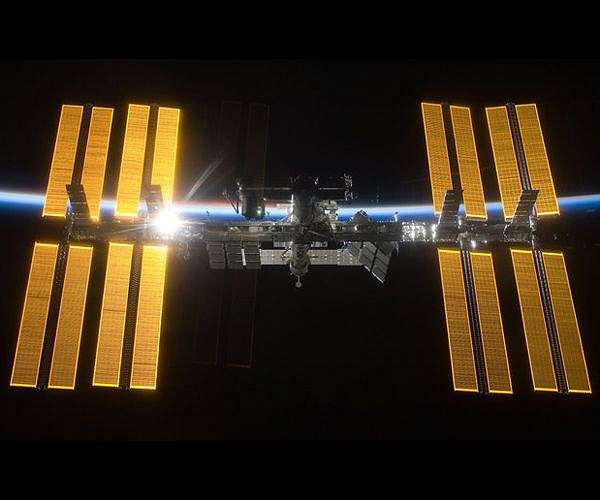
The current 63rd ISS crew includes Russian cosmonauts Anatoly Ivanishin and Ivan Wagner and US astronaut Christopher Cassidy.
"Closing hatches on the American segment and closing the hatch between the American and Russian segments of the station have been carried out", Russia's state space agency Roscosmos said on Friday. The agency added that the crew will remain at the Russian segment until Monday night.
Roscosmos and Mission Control Centre's specialists will monitor the pressure in the closed modules to determine the possible location of an atmospheric leak.
"On Monday morning, 24 August, there will be a discussion on the results of the work, based on which a further action plan will be determined", Roscosmos stressed.
The Russian ISS segment consists of five modules – Zarya, Pirs, Poisk, Rassvet, and Zvezda, the latter being the one where the crew is currently self-isolated.
Earlier in the day, the agency said that an inspection of pressure in Russia's Rassvet and Pirs modules at the International Space Station, launched after a suspected leak of oxygen in one of the US modules, has found no traces of air leakage.
According to NASA, the leakage was first detected back in September of last year, but its intensity increased only recently. Works were launched to find the source and the preliminary findings are expected to come by late next week.
earlier report
Air Pressure Check Finds No Oxygen Leak in 2 ISS Russian Modules, Roscosmos Says
An inspection of pressure in Russia's Rassvet and Pirs modules at the International Space Station (ISS), launched after a suspected leak of oxygen in one of the US modules, has found no traces of air leakage, Russia's state space agency Roscosmos said on Friday.
"The ISS is carrying out works to determine the increase in atmospheric leakage relative to average standard leakage per day", Roscosmos said, specifying that the crew closed hatches of the Russian modules Rassvet and Pirs and the Progress MS-15 cargo spaceship.
"As reported by the ISS crew, controlling the pressure levels in the modules, the pressure remains normal".
The Russian ISS segment consists of five modules – Zarya, Pirs, Poisk, Rassvet and Zvezda, the one where the crew are currently self-isolated.
On 19 August, Roscosmos said that the ISS cosmonauts and astronauts had self-isolated in the space station's Russian segment for three days after suspecting a small air leak in the US segment.
According to NASA, the leakage was first detected back in September of last year, but its intensity increased only recently. While it still poses no threat to the crew, works were launched to find the source – presumably a 0.1 millimetre (0.04 inch) hole in one of the US modules – and the preliminary findings are expected to come by late next week.
The current ISS crew includes Russian cosmonauts Anatoly Ivanishin and Ivan Wagner and US astronaut Christopher Cassidy.
earlier report
Oxygen Leak Registered on International Space Station, Possibly in US Section, Source Says
Currently, NASA astronaut Drew Morgan, European Space Agency astronaut Luca Parmitano, and Russian cosmonaut Alexander Skvortsov are on board the International Space Station (ISS). The three spacemen arrived on the ISS on 20 July and will return to Earth in December or January.
A small air leak has been detected on the International Space Station (ISS), possibly in the American segment, but it does not threaten the safety of the crew, a source said.
"According to the chief control of the Russia section of the ISS, the station's crew will move to the Zvezda module on Friday to control the pressure in the modules of the US sector", Roscosmos said.
The decision was made jointly with the United States. The crew will carry out regular tasks during the three days it will spend in the Russian section. Roscosmos confirmed that the crew was not in any danger.
The source said earlier that they plan to isolate the US module on the station by closing the hatches between the segments.
According to the source, the air leak does not pose a threat to the safety of the ISS and its crew.
Russian cosmonauts Anatoly Ivanishin and Ivan Wagner, as well as American astronaut Christopher Cassidy, are staying on the ISS.
The last time an air leak on the ISS was recorded was on 30 August 2018. It turned out that the reason was a man-made hole in the Soyuz spacecraft. The cosmonauts filled the hole with a sealant, but the cause of it is still unknown. A Roscosmos commission determined out that the ship could have been damaged on Earth.
In 2004, an air leak was discovered on the US segment of the ISS. After a long search, the astronauts discovered that it was located in the hose on the porthole of the Destiny module.
