
Japan began a campaign Sunday to convince communities hosting nuclear reactors to let operations resume, with several local governments blocking nuclear power generation after the atomic crisis in Fukushima.
Central government officials held a briefing in Saga prefecture, where two reactors at the Genkai power plant are among several across the country that were halted for regular checks when a huge quake and tsunami hit on March 11.
Local officials have since withheld routine consent for operations to resume, citing safety concerns after the tsunami triggered a crisis at the Fukushima Daiichi plant, which has leaked radiation into air, soil and sea.
Sunday's briefing was broadcast online, but only seven government-selected local residents were allowed to attend, while the meeting venue was not disclosed to the public.
In a press conference after the 90-minute briefing, one of the seven complained that it had been "way too short".
Another participant said: "Officials used many technical terms that were too difficult to understand. Since I didn't understand, I cannot agree with their explanation."
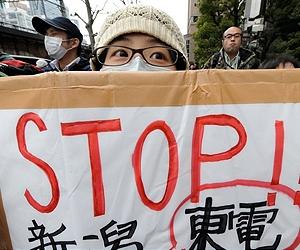
Dozens of protesters demonstrated outside the building against the government's nuclear policy.
"This is a programme designed to lead to an approval for the resumption of operations of the Genkai reactors. We cannot accept that," one of the protesters, Hatsumi Ishimaru, 59, was quoted by Kyodo News as saying.
Nuclear energy makes up about a third of Japan's overall energy supply, but the government has faced stiff criticism from the public on the issue since the Fukushima crisis forced the evacuation of thousands of local residents.
earlier related report
Japan PM may step down by mid-August: lawmakers
Tokyo (AFP) June 26, 2011 –
Japan's unpopular Prime Minister Naoto Kan may step down by mid-August if parliament passes key bills for disaster reconstruction, senior lawmakers said Sunday.
Kan pledged earlier this month to resign soon, but he has also demanded that bills on reconstruction from the March 11 quake, tsunami and nuclear disaster are passed first, along with legislation to promote renewable energy sources.
"Once things settle in late July or early August, I think the conditions for the prime minister to step down will be there," Jun Azumi, a senior member of Kan's Democratic Party of Japan (DPJ), told reporters.
Japan's centre-left government last week pushed through an extension of the parliamentary session by 70 days to the end of August.
The DPJ and its coalition partners plan to use the time to pass the key reconstruction bills — another budget bill on rebuilding the disaster areas, as well as a bill to issue bonds for the current fiscal year to help pay for the recovery efforts.
Kan — who started his political life as an environmental campaigner — also wants to pass a bill to promote renewable energy, having pushed for a rethink on atomic power since the Fukushima Daiichi nuclear plant disaster.
Once these bills get passed, "That'd be about what the prime minister should be responsible for," DPJ secretary general Katsuya Okada told reporters.
"I would like to see opposition parties pass these bills unconditionally," he said during a Fuji TV debate show.
