
While Apple's new iPhone 7 announcement has stirred the ire of many of the brand's fans because of the company's decision to dump analog audio, Japan stands likely to embrace the change. In fact, some local peripheral makers have been ahead of the curve.
Tokyo-based Links International is one of them; the company touts itself as the first major peripherals maker to manufacture a Lightning port-based digital audio headphone system, which it began to market in April, well ahead of Apple's Sept. 7 revelation that it will dump the old 3.5" analog audio jack.
At the time of the announcement, Apple marketing chief Phil Schiller cited space concerns for the move, but was also emphatic. "It really comes down to one word: courage," he said. "The courage to move on to do something new that betters all of us."
"Courage" may not provide enough solace to iPhone lovers forced to upgrade to more expensive headsets in order to enjoy the new audio features. To be fair, Apple will include a set of Lightning EarPods (basically an updated version of existing EarPods with a Lightning port connector), with new iPhone 7 models. The company will also bundle a Lightning-to-3.5mm adapter.
The new "AirPods" – Bluetooth-based wireless earbuds – were also introduced; they will be sold separately and become available in October.
Sales of the new smartphone kick off on Sept. 16.
In a break from tradition, the company said it will not release first-weekend sales numbers. And Apple's stock has not reacted well to the new product announcement. iPhone sales have fallen on-year for the past two quarters.
"Apple's switch to the Lightning port for audio did not come as a big surprise, as it had been rumored for some time," said Links PR officer Takanori Sakaguchi at a recent Tokyo trade show. "The change is good for the industry, and keeps pushing the tech envelope forward."
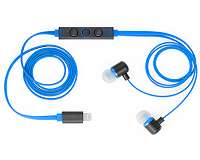
Links' move to mass produce the digital headset accessory for the iPhone 7 is prescient. Its ICEP-LT-04 earphone series sports a 24bit/48kHz digital signal reception, a high grade cable that keeps signal loss to a minimum, a remote volume/playback controller, a digital-to-analog converter (DAC), and includes a portable amp that can boost volume to 105dB, drawing power from the phone.
Colors are available in white, red, green, blue, and grey.
A test run of the new Lightning amp-assisted headphones on hip-hop music impressed, particularly at higher volumes where superior digital signal clarity over analog is perhaps most noticeable. Most serious headphone enthusiasts recommend buying a separate DAC and amp, but they can be bulky; Links' unit is capable and extremely compact. It retails for about 6,000 yen on Amazon Japan.
"Japanese consumers are a bit spoiled when it comes to cool technology, and I doubt there will be any 'analog holdouts,'" says Mr. Sakaguchi. "And there are enough reasons besides digital audio to switch to a new iPhone."
The 4.7-inch iPhone 7 and 5.5-inch 7 Plus have 25% brighter displays, are water- and dust-resistant, and sport greatly expanded memory options. The 7 Plus will also come with a dual lens arrangement for the onboard camera.
For Japan, the new iPhone will also feature the ability to use Apple Pay, and will be accepted anywhere the popular Suica system is available. Maps in iOS 10 will also allow commuters to easily find train fare breakdowns, simplifying commutes.
Among major markets, iPhone market share is highest in Japan (54%), well above that of the U.S. (39.1%) and China (27.1%). Japan has over 121 mobile phone users, which works out to an average of almost one per person.
"Love it or loathe it, the trend in advanced personal tech is to become more digital and less analog. Wireless protocols and the benefits of Lightning make the classic 3.5mm jack redundant," says Vlad Savov of The Verge, a technology appraisal site.
"If you want to buy the headphones of the future, don't cling on to the connector of the past," he adds. "Over time Apple's Lightning and the more universal USB-C standard will take over."
