
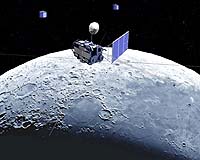
Japan will launch a lunar orbiter on August 16 to collect data for research of the moon's origin and evolution, the Japan Aerospace Exploration Agency said Wednesday. The probe will consist of a main unit, which will circulate 100 kilometres (60 miles) above the moon, and two small satellites, the agency said. It will be launched from the Space Centre on the isle of Tanegashima off the southern tip of Kyushu Island, southern Japan, aboard a domestic H-IIA rocket for a one-year mission.
The explorer is nicknamed "Kaguya," the name of a beautiful princess who charms many men before ascending to her home, the moon, in a popular Japanese folktale.
It will gather data on chemical element distribution, mineral distribution, topographical/surface structures, gravity field and the environment of the moon, the agency said in a statement.
"All of the data gathered by Kaguya will bring us new scientific knowledge for research of the origin and evolution of the moon," it said, adding China and India are due to launch lunar explorers in 2007 and 2008 for similar purposes.
The main orbiter is equipped with lunar radar sounding antennas.
In addition, it carries a high-definition television camera to photograph the Earth rising from the Moon's horizon.
One of the satellites transmits communications from the orbiter to the Earth and the other is used to measure the position and precession of the moon precisely, the statement said.
Source: Agence France-Presse
