
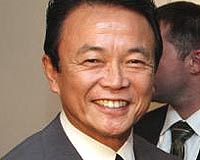
Japanese Premier Taro Aso welcomed the leaders of a clutch of small Pacific islands Friday for a meeting expected to generate fresh aid for clean energy and coping with climate change.
Aso was also expected to provide details of increased aid for "human security" projects in the region, including the provision of water-related assistance, at the fifth Pacific Leaders Meeting in northern Japan.
"As a partner with Pacific island countries and sharing the Pacific Ocean we will do as much as we can to help Pacific islands try to overcome their challenges," Aso told visiting leaders at the two-day summit.
Japan wants to share its technology and know-how, he said.
Tokyo will announce fresh development assistance for the islands that "could be more" than its pledge of 45 billion yen (480 million dollars) at the last such meeting three years ago, a Japanese foreign ministry official said.
It is the latest windfall for the isolated states as major powers try to win their hearts and minds — and their votes in international forums.
While small in size, the islands hold 12 critical votes at the United Nations, where Japan is seeking a permanent Security Council seat, a goal strongly opposed by China, which is also wooing the Pacific.
Leaders or officials from Australia, the Cook Islands, Fiji, Kiribati, the Marshall Islands, Micronesia, Nauru, New Zealand, Niue, Palau, Papua New Guinea, Samoa, the Solomon Islands, Tonga, Tuvalu and Vanuatu were attending.
Fiji's military leader Voreqe Bainimarama — who overthrew the elected government in a 2006 coup — was not invited.
Last month, the military regime tightened its grip on power, leading to its suspension from the Pacific Islands Forum, a regional bloc.
Niue Premier Toke Talagi said the strong relationship between Japan and the islands came from "shared values of democracy, good governance, the rule of law, freedom of press and the promotion of economic development."
Japan was "a significant aid and trade partner" for the region, "and we look forward to it continuing," Talagi said.
At a reception ahead of the summit, Foreign Minister Hirofumi Nakasone said "environment and climate change, human security and people-to-people exchanges" would be the foundation for Japan's partnership with the Pacific islands.
"We have a vision of a Pacific environmental community," Nakasone said. "We will continue to assist nation building by utilising environmental technology."
Increasingly extreme droughts and sea water inundation on low islands are causing hardships for islanders across the region.
In Kiribati, a 16-month drought has forced the government to deliver drinking water by ship to remote islands that depend on rain for fresh water, its President Anote Tong said at a roundtable in Tokyo this week.
The Marshall Islands' ability to provide drinking water and adequate sanitation is "constrained by lack of money, skills and transfer of technology," President Litokwa Tomeing said.
A study of Majuro, the capital, showed that 30 percent of the estimated 30,000 people in the urban centre have no direct access to fresh water or sanitation facilities.
Share This Article With Planet Earth
