
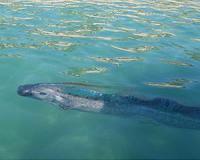
Oarfish, a long eel-like fish, or lamprid, populate temperate to tropical oceans but are rarely seen, preferring to stick to the deeper, murkier depths — between 650 and 3,000 feet.
But two kayakers paddling through the coastal waters of Baja, Mexico, happened upon two oarfish swimming in the crystal clear shallows of the Sea of Cortés. Luckily, they had their camera ready.
A member of the Regalecidae family, oarfish maintain their long, slender shape by snacking mainly on tiny zooplankton, shrimp and other crustaceans. They will also gobble up small squid and fish. And though oarfish are rather large, they are of limited commercial value, as their jelly-like meat is filled with hundreds of tiny bones.
Typically, oarfish are only seen when they was ashore dead or drift into the shallows due to sickness or injury.
Video of bison fleeing Yellowstone a hoax
Park County, Wyo. (UPI) Apr 8, 2013 –
Last week, a video of bison purportedly galloping out of and away from Yellowstone National Park went viral. Online commenters and local news stations entertained ideas that the bison were fleeing an earthquake or an impending volcanic eruption.
But as The Daily Beast reports, the video is a hoax (or has been at least been greatly misrepresented). Yellowstone officials recently pointed out that the video, originally uploaded to YouTube in late March, features bison running into the park — towards the volcano, not away.
"There are no animals fleeing the park because of an earthquake," Al Nash, spokesman for Yellowstone National Park, told the Great Falls Tribune.
Even if this video doesn't show animals leaving the park, Nash says they do wander off parklands this time of year — in search of thawed food and fresh grass in warmer, lower elevations.
"What we typically see this time of year is the animals are hungry," he said. "As the snow melts and things get green in the park, they'll walk back in."
