
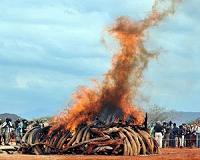
Kenya on Wednesday launched a three-week amnesty to hand in ivory and rhino horn ahead of the world's biggest burning of ivory next month.
The mass burning, the vast majority of its ivory and rhino horn stockpile, will amount to some 105 tonnes of ivory, seven times the size of any ivory stockpile destroyed so far, as well as 1.35 tonnes of rhino horn.
"Anybody holding any ivory, rhino horns or any other wildlife trophies or jewelry or trinkets made from these materials should surrender them," environment minister Judi Wakhungu told reporters, as preparations for the giant burning ceremony were launched in Nairobi national park.
"Those who take advantage of this amnesty will not be punished."
The highly publicised display on April 30 will be led by Kenyan President Uhuru Kenyatta and attended by a gaggle of celebrities, conservationists and heads of state.
Kenyatta set fire in March 2015 to a giant pile of 15 tonnes of elephant ivory, which conservationists said then was the largest ever burned in Africa.
At the time, the pile of tusks formed a dramatic three-metre (10-foot) tall pyre, which burned for several days until the ivory was reduced to ash.
"Although the destruction of ivory and rhino horn will not in itself put an end to the illegal trade in these items, it demonstrates Kenya's commitment to seeking a total global ban in the trade of ivory and rhino horn," Wakhungu added.
More than 30,000 elephants are killed for their ivory every year in Africa to satisfy demand in Asia where raw tusks sell for around $1,100 (1,000 euros) a kilogramme (2.2 pounds).
"The poaching of elephants and rhinos and illegal wildlife trade is a major problem across much of Africa, it threatens the very survival of these iconic species," Wakhungu said.
"Poaching is facilitated by international criminal syndicates and fuels corruption."
Man mauled, lion shot in latest Nairobi incident
Nairobi (AFP) March 30, 2016 –
A man was injured by a lion that was subsequently shot dead by wildlife rangers as it was roaming outside the Kenyan capital Nairobi on Wednesday.
It is the fourth time this year that lions have roamed outside Nairobi National Park and the second time someone has been injured by a lion in less than two weeks.
The dark-maned male lion was shot by a Kenya Wildlife Service (KWS) ranger after it hurt a passer-by near Isinya, a built-up area south of the capital where onlookers were gathering to stare at the agitated animal.
"The stray lion that was roaming in Isinya has been shot dead after injuring a person," said KWS spokesman Paul Udoto.
Udoto said the injured man had been taken to hospital and the animal shot "after it (had) become wild".
In previous incidents this year the lions have either been herded back to the 117 square kilometre (29,000-acre) park or have returned of their own accord.
The reserve is almost surrounded by a fast-growing city of over three million people.
Earlier this month a 63-year old man was injured when a lion clawed at him close to a busy highway where motorists were honking their horns and snapping photographs and videos as they drove by.
The park is not entirely fenced to enable traditional migration by animals in search of grazing.
The big cats are under growing pressure as one of Africa's fastest growing cities expands onto ancient migration routes and hunting grounds.
Conservationists say lions lived there before people in the area and are not "escaping" the park nor "straying" into human settlements, rather people have moved into the lions' habitat.
In mid-February, two lions spent a day wandering through Kibera, a densely-packed city slum, before returning to the park, and days later more lions were spotted in town.
