
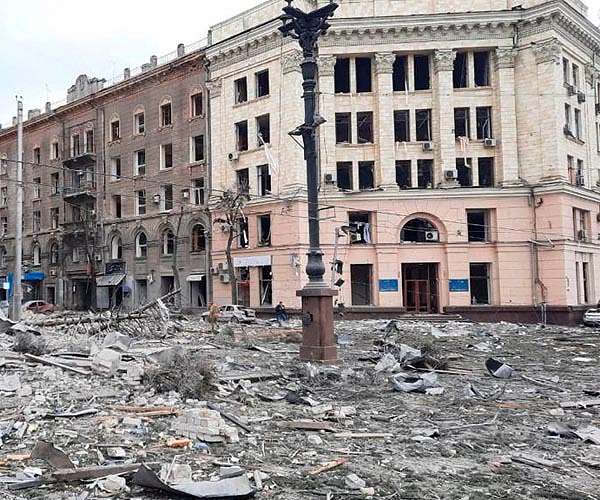
New trenches, concrete blocks, sandbags and numerous checkpoints appear to be everywhere around Kharkiv, which has pushed back one Russian assault on Ukraine's second city, and is preparing to defend against another.
A pink stuffed toy marks the entrance to one freshly dug trench in the regional capital.
The cut earth is still soft and black and the soldiers are down to their vests, soaking up the sun.
Tensions have eased in this northeastern corner of Ukraine, but Kharkiv, just 50 kilometres (30 miles) from the Russian border, remains under permanent threat, and a second line of defence has been organised behind the first.
"When we were here on the 24th of February there were no positions at all," says "Doctor", a medic with the National Guard, referring to the day the Russian invaded.
"Our warriors were laying by the road behind hills and were shooting, we had fire contacts," he explains.
"But now when we have trenches, we have well protected zones, so for them, it would be impossibly hard to capture (this position), adds the nurse who agreed to give a guided tour of just a few dozen metres of the site, which falls under military secrecy rules.
Nearby stands a car daubed with the inscription "Skill to kill".
Directly to the east of Kharkiv, a recently built trench runs from a house that was bombed and burnt out during the first Russian attack.
The trench line heads off to the south in a zigzag intended to limit the destruction a shell would cause.
The fortifications double back like a maze, which the army refuses to allow reporters to visit. Further down, bunker positions can nonetheless be seen, built up higher on concrete blocks.
Wooden crates line the ground so people can walk around without sinking into the mud when it rains.
"Now our armed forces of Ukraine are in counter-offensive, repelling the enemy from our own territories," Doctor says in English.
"Sometimes we could be under the shelling as well, but we are here and do not let anybody capture the city."
– 'We have a problem' –
Kharkiv lies well within the Russians' range, and every night shells hit the town where the remaining population has learned to live with the boom of artillery from both sides.
One woman, who has lived in the city's metro since the fighting started, says Ukraine is waiting for Western aid to arrive, and particularly "American armaments which will help us win" the war.
On the roads leading out of the city — some of which have been closed off — men and women civilians help soldiers to fill sandbags for the checkpoints.
"We have a problem, we are at war," jokes a soldier as he checks a vehicle and turns it back.
"Doctor", who is a nurse, voices confidence the Russians will not be in the region much longer.
"They use drones to see our position," he says.
"We know where they are, and our armed forces know where they are and very soon, they will not be there where they are now."
And yet, he knows there may be plenty more fighting to do.
They have been holding the position for nearly three months, he points out.
"Everyone is ready, we all have fighting spirit," which he knows from talking to people every day, he says.
"Nobody is going to run or retreat. We are the national guards, and we are going to hold our place and our city till the end."
Several hurt in Russian strike on Ukraine culture centre
Kyiv, Ukraine (AFP) May 20, 2022 – At least eight people, including a child, were wounded when a powerful Russian missile strike gutted a newly repaired cultural centre in eastern Ukraine, the authorities said on Friday.
President Volodymyr Zelensky said on social media that Russia had targeted "the newly renovated House of Culture", in the town of Lozova, in the eastern region of Kharkiv. He described the attack as "absolute evil" and "absolute stupidity".
Kharkiv regional governor Oleg Sinegubov said eight people had been wounded, including an 11-year-old girl. All had been hit by shrapnel. A local health official had earlier put the number of wounded at seven.
Fire broke out in the cultural centre after the missile strike which also damaged nearby buildings, Sinegubov said, adding that Russian forces had fired three missiles towards the 1,000-capacity building, the largest cultural centre in the region.
"There is no doubt the occupiers directly targeted (it)," he said on Telegram.
Two of the missiles had been intercepted and the blaze had been extinguished, he added.
"The occupiers have identified culture, education and humanity as their enemies. And they do not spare missiles or bombs," Zelensky wrote on Telegram.
He added a video to his message showing a large explosion at the building, sending debris flying in all directions, followed by clouds of thick black smoke. Residential complexes could be seen nearby and two passing cars, one of which sped up to escape the area.
Defence Minister Oleg Motuzianyk said the situation on the eastern front was tense on Friday and appeared to be worsening.
He told a press conference that Russian forces were firing all along the line of contact and trying to shell deep into Ukrainian defensive lines.
Russia has routinely been accused of targeting civilian infrastructure since it launched its invasion of Ukraine on February 24. The conflict has devastated several towns and cities.
Mariupol in the south has suffered near total destruction. Moscow's forces were accused of striking a theatre in the southern port city in March, killing hundreds of civilians sheltering there.
