
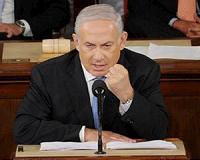
Israeli Prime Minister Benjamin Netanyahu's claim that Iran was a year away from making a nuclear bomb was contradicted by his secret services, according to reports Monday citing leaked documents.
The inconsistency was revealed in a cache of communications between South African intelligence services and their global partners — including Israel's Mossad and America's CIA — that were leaked to Qatar-based news network Al-Jazeera and Britain's The Guardian daily.
In 2012 Netanyahu told world leaders at the United Nations that Iran could create a nuclear weapon within a year, brandishing a diagram in the form of a lit bomb to indicate the advanced state of Tehran's development effort.
He warned the world that unless Iran was stopped, as of mid-2013 it would only need "a few months, or even a few weeks" of additional uranium enrichment activity to develop a bomb.
But weeks after the speech, Mossad shared a report with South African intelligence which concluded Iran was "not performing the activity necessary to produce weapons," according to the Guardian.
The discrepancy, the paper said, "highlights the gulf between the public claims and rhetoric of top Israeli politicians and the assessments of Israel's military and intelligence establishment."
The revelations come at a politically sensitive moment as the United States, China, Russia, Britain, France and Germany face a March 31 deadline to reach a deal with Iran to limit its nuclear programme in return for an easing of economic sanctions.
Iran denies seeking an atomic bomb, insisting that its nuclear programme is purely for peaceful energy purposes.
An Israeli government official told the Guardian that there was no contradiction between Netanyahu's statements and the report, claiming both state Iran was enriching uranium to produce weapons.
The leaked documents dating from 2006 to late 2014 consist mainly of communications between South Africa's intelligence agency and other agencies around the world, such as Britain's MI6, Russian intelligence and the CIA.
Iran opposition unveils 'secret' Tehran nuclear site
Washington (AFP) Feb 24, 2015 – An exiled Iranian opposition group Tuesday accused Tehran of running a "secret" uranium enrichment site close to Tehran, which it said violated ongoing talks with global powers on a nuclear deal.
"Despite the Iranian regime's claims that all of its enrichment activities are transparent … it has in fact been engaged in research and development with advanced centrifuges at a secret nuclear site called Lavizan-3," said Alireza Jafarzadeh, deputy director of the National Council of Resistance of Iran(NCRI).
He said the site was hidden in a military base in the northeastern suburbs of Tehran.
He presented to reporters a series of satellite images drawn from Google Maps which he said backed "this intelligence from highly placed sources within the Iranian regime as well as those involved in the nuclear weapons projects."
The Lavizan-3 site was apparently constructed between 2004 and 2008 and has underground labs connected by a tunnel.
"Since 2008, the Iranian regime has secretly engaged in research and uranium enrichment with advanced… centrifuge machines at this site," Jafarzadeh said.
The group had shared its information with the US administration, he added.
The existence of the site was "a clear violation" of the nuclear Non-Proliferation Treaty as well as UN resolutions and an interim November 2013 deal struck with global powers gathered in the P5+1 group, he said.
Under the interim accord, Iran agreed not to allow "any new locations for enrichment" and to provide IAEA, the UN nuclear watchdog, all information about its nuclear facilities.
"It is absolutely senseless to continue the negotiations," added Jafarzadeh.
The NCRI is a political umbrella of five Iranian opposition groups, the largest of which is the People's Mujahedeen Organization of Iran, which was once banned in Europe and the United States as a terror group.
The People's Mujahedeen has long opposed the nuclear negotiations, and with the NCRI has made several important revelations of the existence of secret nuclear sites in Iran.
The so-called P5+1 group of Britain, China, France, Russia, the United States and Germany is trying to strike an accord that would prevent Tehran from developing a nuclear bomb.
In return, the West would ease sanctions imposed on Tehran over its nuclear program, which Iran insists is purely civilian in nature.
A new March 31 deadline is looming for agreement on a political framework, after two previous dates for a comprehensive deal were missed.
"Despite the Iranian regime's claims of transparency, these nuclear activities, today's intelligence, makes clear it has been continuing to lie for more than a decade," added NCRI member Soona Samsami.
