
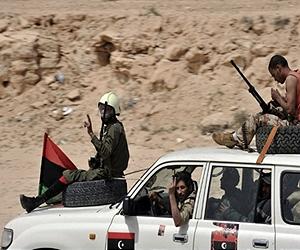
Libyan rebels' foreign relations chief Ali al-Essawi urged NATO to step up air strikes on Moamer Kadhafi's tanks and missile sites, at an international meeting in Doha on Wednesday.
"Civilians are not sufficiently protected," Essawi told AFP on the sidelines of the first meeting of the Libya contact group.
"We want more air strikes against tanks and missile launch sites" of forces loyal to Kadhafi, he said.
The North Atlantic Treaty Organisation, which has commanded military operations in Libya since the end of last month, says 30 percent of Kadhafi's forces have been destroyed since UN-authorised strikes were launched March 19.
Essawi also said Libyan rebels were willing to hold talks with "any defector" from Kadhafi's regime, including former foreign minister Mussa Kussa.
"We would welcome to speak to anybody who defects or wants to defect, to help them. We would speak to anybody who would give information to help the Libyans in this situation," he said.
Asked if the Transitional National Council, the rebels' shadow government, was willing to talk to Kussa, he said: "Why not?"
Britain and France on Tuesday pressed NATO allies to step up air raids in Libya by deploying more combat jets to protect civilians.
Essawi had said on Tuesday that Kadhafi forces have killed 10,000 people, while 20,000 were missing and 30,000 wounded, while calling for "more efforts regarding protection of civilians against this aggression."
There was no immediation confirmation of the claim.
earlier related report
US says fighter jets still bombing Libya air defenses
Washington (AFP) April 13, 2011 –
US fighter jets are still carrying out bombing raids on Libya's air defenses, the Pentagon said Wednesday, days after indicating American combat aircraft had withdrawn from NATO operations.
US warplanes have attacked air defense targets in three strikes since April 4, when NATO assumed command of the air campaign, spokesman Colonel Dave Lapan said in a statement.
US military officials had previously said about 50 combat jets had been pulled back after the handover to NATO, and that air strikes would be carried out by allies while the United States would provide refueling and surveillance aircraft.
It was unclear why the Pentagon had waited to reveal the role of F-16 fighters helping to enforce the no-fly zone, but details emerged amid divisions within the NATO alliance over the air campaign.
Britain and France, which led the calls for international intervention to stop Moamer Kadhafi's attacks on his people, have pressed NATO allies to share more of the burden for the operation and deploy more combat aircraft.
Lapan said the combat flights by F-16 fighters were confined to striking radar and other air defenses as part of the UN-mandated no-fly zone in Libya.
But US combat aircraft were not part of bombing runs against tanks or other ground targets that fell under a separate UN-approved mission to protect civilians against Kadhafi's forces, he said.
For that mission, American ground-attack aircraft and other warplanes remain on standby pending a request from NATO.
Lapan told reporters earlier that "we have fighter aircraft that NATO has, that they can use as part of the air tasking order for suppression of air defense missions, and they have conducted some of those missions."
The United States had assigned 11 aircraft, including six F-16 fighters and five EA-18 Growlers for electronic jamming, to target air defenses as part of the no-fly zone mission, he said.
Since April 4, US pilots had flown 97 sorties to suppress the regime's radar and anti-aircraft weaponry, he added.
President Barack Obama's administration, which has nearly 100,000 troops fighting a grinding war in Afghanistan while it tries to wind down the US mission in Iraq, has been eager for Western allies to bear the brunt of the Libya operation.
The Pentagon insisted that the United States was playing a secondary role despite the revelation that United States was still bombing Libyan targets.
"We are in a support role," Lapan said.
Defense Secretary Robert Gates and other top officers have said the US military — which played a dominant role in the opening stage of the Libya operation — would shift to a focus on mid-air refueling, surveillance flights and search and rescue missions.
Since April 1, the US military has flown 35 percent of all sorties in Libya, 77 percent of all aerial refueling operations and 27 percent of surveillance and intelligence flights, according to the Pentagon.
Share This Article With Planet Earth
