
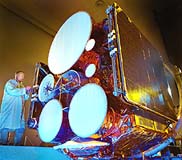
A U.S. Air Force/Lockheed Martin team has announced that the Defense Satellite Communications System (DSCS) III constellation has surpassed 200 years of on-orbit operations, the longest total operational experience of any U.S. military communications satellite constellation.
Lockheed Martin designed and built 14 DSCS spacecraft for the Military Satellite Communications Wing at the Air Force's Space and Missile Systems Center, Los Angeles Air Force Base, Calif. The system provides uninterrupted secure voice and high-data rate communications to Department of Defense users; essential tools in monitoring events and deploying and sustaining forces anywhere in the world.
The DSCS III satellites have a design life of 10-years, however, the team's ability to manage and maximize fuel usage allowed the satellites to exceed their design life by several years. Currently, 10 spacecraft provide or have provided service for a total of over 71 years beyond their design lives and continue to perform with outstanding results.
"We take great pride in the DSCS constellation's proven performance and the added value it is providing to the nation as it exceeds its design life," said Kevin M. Bilger, Lockheed Martin's vice president and general manager of Global Communications Systems.
"DSCS's reliability has served as the backbone of military communications capabilities and will continue to play a pivotal national security role for years to come."
Lockheed Martin is also progressing on the U.S. Air Force's protected and highly secure communications satellite system, the Advanced Extremely High Frequency (AEHF) program.
AEHF satellites will replace the Lockheed Martin-built Milstar constellation, increase data rates by a factor of five and the number of connections by a factor of two, permitting transmission of more tactical military communications, such as real-time video, battlefield maps and targeting data.
The first Lockheed Martin-built AEHF spacecraft has completed initial thermal vacuum testing and is planned for delivery to the Air Force in 2010. The current Milstar constellation continues to provide secure, reliable and robust communications to U.S. and Allied Forces. By April, the constellation will surpass 50 total years of on orbit operations.
The company is leveraging its unparalleled expertise in fielding proven technologies for advanced military communications systems, as it leads a team in the competition for the next-generation Transformational Satellite Communications System (TSAT). TSAT provides significantly more capacity and connections than the Milstar and AEHF systems, improving availability of protected satellite communications for future military operations.
